
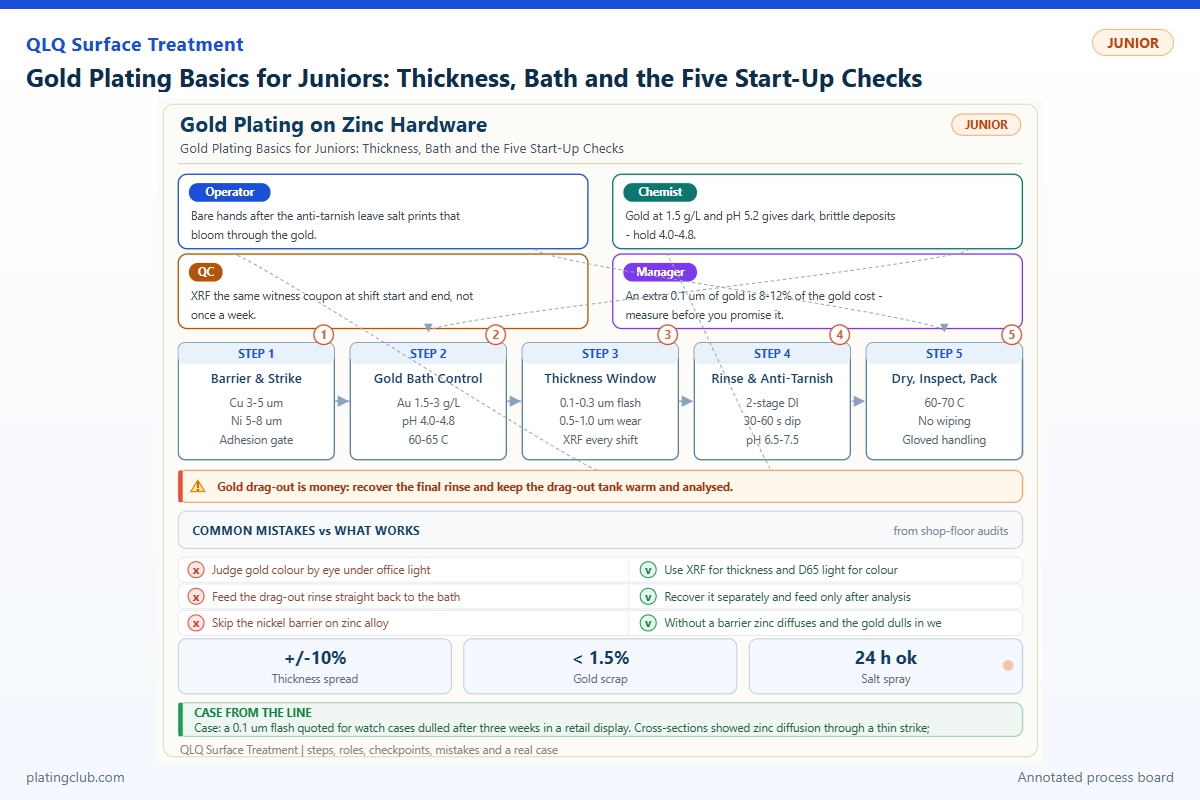
Gold looks like a colour and behaves like a measurement. Juniors who learn four numbers - thickness, gold concentration, pH and temperature - stop guessing and start hitting the specification on the first rack.
0.1-0.3 um
Flash gold
0.5-1.0 um
Wear gold
4.0-4.8
Bath pH
The four numbers on the gold bath
| Number | Target | Range | What happens outside it |
|---|---|---|---|
| Gold concentration | 2.0 g/L | 1.5-3.0 g/L | Low: thin, slow; high: drag-out loss |
| pH | 4.4 | 4.0-4.8 | High: dark brittle deposits; low: poor coverage |
| Temperature | 62 C | 60-65 C | Cold: dull and slow; hot: fast, harder to control |
| Current density | 0.5 A/dm2 | 0.2-1.0 A/dm2 | High: burnt edges; low: patchy colour |
Flash vs wear gold: what you are selling
| Type | Thickness | Use | Life in service |
|---|---|---|---|
| Flash | 0.1-0.3 um | Display, indoor fashion | Months of light handling |
| Standard wear | 0.5-1.0 um | Worn hardware, clasps | 1-3 years |
| Heavy wear | 1.0-2.0 um | Handled daily, keys, buckles | 3+ years |
Five start-up checks before the first rack
| # | Check | Pass number |
|---|---|---|
| 1 | Bath temperature | 60-65 C |
| 2 | pH meter calibrated | 4.0-4.8 reading |
| 3 | Gold analysis current | < 7 days old |
| 4 | Barrier layer present | Cu 3-5 um + Ni 5-8 um |
| 5 | Witness coupon ready | XRF before and after shift |
Watch out
Never assess gold by eye under office light. Colour changes with the light source; thickness only changes with the meter.
Common mistakes and the fix
| ✗ Call a rack 'good' because it looks yellow | ✓ XRF a witness coupon from the rack |
| ✗ Skip the nickel barrier on zinc | ✓ Zinc diffuses through thin gold and dulls it in weeks |
| ✗ Handle parts bare-handed after the anti-tarnish | ✓ Use gloves; salts print through the gold |
| ✗ Set current from memory | ✓ Read the calculation sheet for the load area |
What each role watches
| Operator | "Keep the load below the current-density limit on the sheet." |
| Chemist | "Gold and pH analysis at fixed times; record temperature with the sample." |
| QC | "XRF a coupon every shift; keep the readings on one sheet." |
| Manager | "Quote thickness bands, not single numbers - the customer buys a band." |
From the shop floor
Case: a junior ran a rack at double current density 'to make it brighter'. The edges burned and the batch was stripped. The calculation sheet now hangs by the rectifier.
FAQ
What is the difference between flash and hard gold?
Flash is a very thin decorative layer; hard gold is thicker and alloyed for wear. Choose by service life, not price alone.
Why does gold go dull after a few weeks?
Usually zinc diffusion through too thin a barrier layer, or poor rinsing before the anti-tarnish dip.
How often is XRF needed?
At least once per shift, and on every new load geometry.
Where to go next
- Level guide for this trade: Gold & Precious Plating — technician levels
- Other levels: Intermediate, Senior, Management
- Owner view: Process Overview for owners
- Supplier view: Chemistry & Supply · Find content by trade + level
Related reading in this trade