
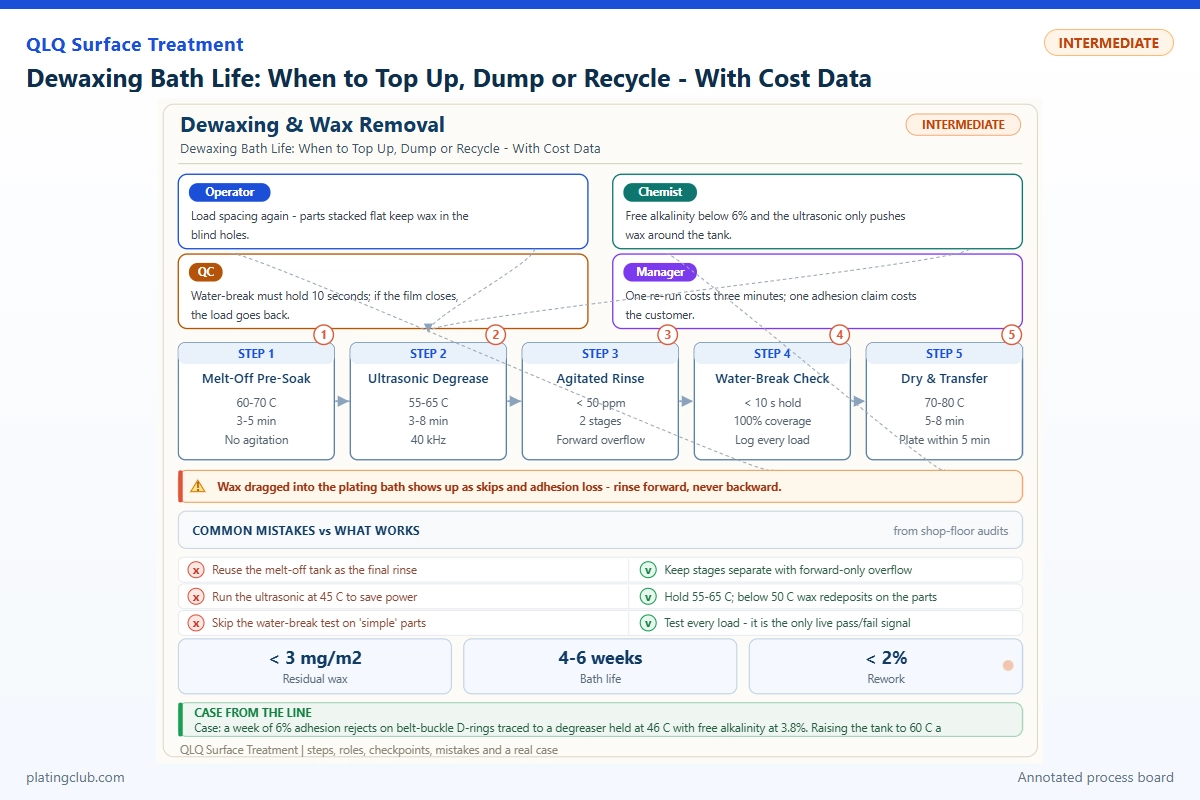
Bath life is a money decision disguised as a chemistry decision. Top-up too little and you pay in rejects; dump too often and you pay in water, heat and wastewater fees. Here is where the line sits, with the arithmetic.
4-6 weeks
Bath life
0.5-1.0 kg/day
Top-up
25-40%
Water/waste saving
Decision rules for a 600 L tank, single shift
| Situation | Indicator | Do this | Typical cost impact |
|---|---|---|---|
| Normal week | Free alkali 6.5-8.5% | Top up 0.5-1.0 kg/day | Baseline |
| Heavy soil | Oil > 2% by volume | Skim, then partial 20% dump | + EUR 0.9 per 1,000 parts |
| Drifting | Alkalinity falls 1.5 pts/day | Investigate rinsing and wax type first | Rejects cost 10x the chemical |
| End of life | Tank rebuild needed weekly | Full rebuild + inspect heaters | EUR 40-70 per rebuild |
Cost per 1,000 parts (illustrative, single shift)
| Item | Top-up only | Weekly partial dump | Full rebuild weekly |
|---|---|---|---|
| Detergent | EUR 3.10 | EUR 4.20 | EUR 6.80 |
| Water + heat | EUR 1.40 | EUR 2.60 | EUR 5.10 |
| Wastewater | EUR 0.60 | EUR 1.30 | EUR 2.90 |
| Rework (at 2%) | EUR 0.80 | EUR 0.80 | EUR 3.20 |
| Total | EUR 5.90 | EUR 8.90 | EUR 18.00 |
Three signals that recycling beats dumping
| Signal | Threshold | Recycling option |
|---|---|---|
| Oil layer visible | > 2% volume | Coalescer / skimmer, reuse 60-80% of the bath |
| Alkalinity recovered on top-up | < 15% drop per week | Ultrafiltration loop, extend to 8-10 weeks |
| Wastewater cost | > EUR 2 per 1,000 parts | Batch treatment with pH correction and reuse |
Watch out
Never dump a hot bath to the drain. Cool it, pH-correct it and log the volume - wastewater rules are where a cheap habit becomes an expensive incident.
Common mistakes and the fix
| ✗ Top up with cold water only | ✓ Top up with warm water plus the right chemical ratio |
| ✗ Measure cost per litre instead of per 1,000 parts | ✓ Per-litre maths hides rework cost completely |
| ✗ Let the oil layer ride on top | ✓ Skim daily; the oil is what blocks the rinse |
| ✗ Rebuild the tank when the heater has failed | ✓ Check heaters every rebuild - that is often the real cause |
What each role watches
| Operator | "Skim the surface before the first load, not at the end of the day." |
| Chemist | "Track oil volume weekly and pair it with alkalinity trend." |
| QC | "Tie every bath action to a batch and a reject count." |
| Manager | "Compare cost per 1,000 parts monthly; it is the only number that matters." |
From the shop floor
Case: a shop cutting bath changes from weekly to monthly saved EUR 2.10 per 1,000 parts in chemicals and water, but lost 1.4% to adhesion until the alkalinity trend was automated. The final answer was a monthly rebuild plus daily top-up - the cheapest column above.
FAQ
How do I measure oil loading quickly?
Take a 100 ml sample in a clear jar, let it stand 30 minutes and read the oil band. One millimetre on a 100 ml sample is roughly 1% by volume.
Can I reuse the rinse water?
Yes, if you add a cascade and a final DI stage. Counter-flow rinsing typically cuts rinse water by 60% without losing quality.
When is a rebuild cheaper than a top-up?
When a top-up holds for less than a day. That means the bath is saturated with soil and chemistry cannot fix it.
Where to go next
- Level guide for this trade: Dewaxing & Ultrasonic Cleaning — technician levels
- Other levels: Junior, Senior, Management
- Owner view: Process Overview for owners
- Supplier view: Chemistry & Supply · Find content by trade + level