
Professional Zinc Alloy Surface Finishing Solutions
Potassium Dichromate
Potassium Dichromate
Tạo mã QR
-
Estimated Delivery:Oct 02 - Oct 06
-
Free Shipping & Returns: On all orders over $75
Product description
Shipping & Return
Product Overview
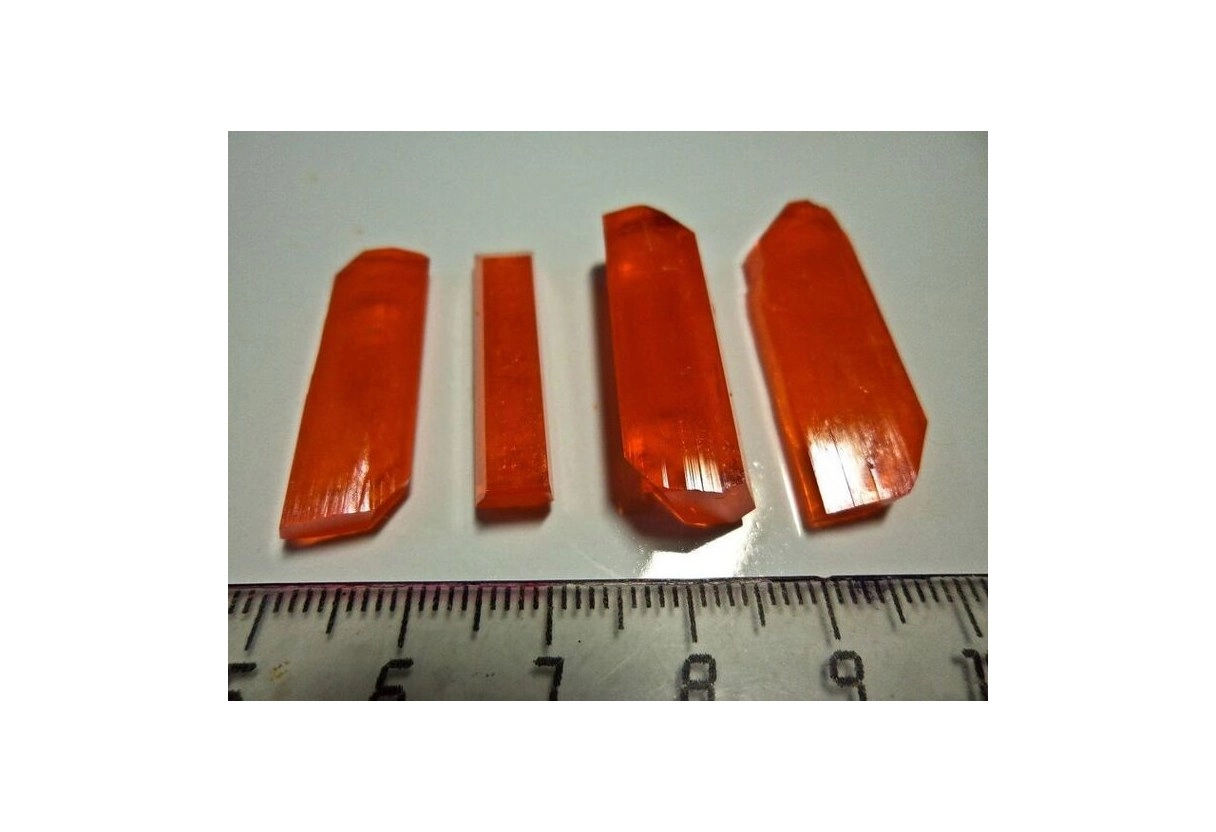
Potassium Dichromate (K2Cr2O7) is the classic hexavalent-chromium salt of the conversion-coating world - bright orange-red crystals that give yellow (iridescent) chromate finishes on zinc and cadmium, the traditional dichromate seal for anodized aluminium, and tarnish-retardant dips for copper alloys. It is a strong oxidizer and, in dilute acid solution, it reacts with zinc or cadmium surfaces to grow a thin, self-healing chromate film whose yellow iridescence has meant "corrosion protected" to generations of inspectors. Plating-grade technical salt is sold with tight chloride, sulfate and iron limits and a guaranteed assay; lower grades go to pigment, leather and reagent markets. Compliance first: hexavalent chromium is restricted in the European Union (REACH - among the most heavily regulated substances in finishing), in automotive ELV and RoHS electronics, and in many export markets. Where the customer's specification allows it and local law permits, conventional yellow chromate still runs - but the responsible supplier states clearly what the salt is for and what it is not, and supports trivalent or Cr-free alternatives wherever regulation demands them.
Product Identity (Encyclopaedia Card)
| Property | Value |
|---|---|
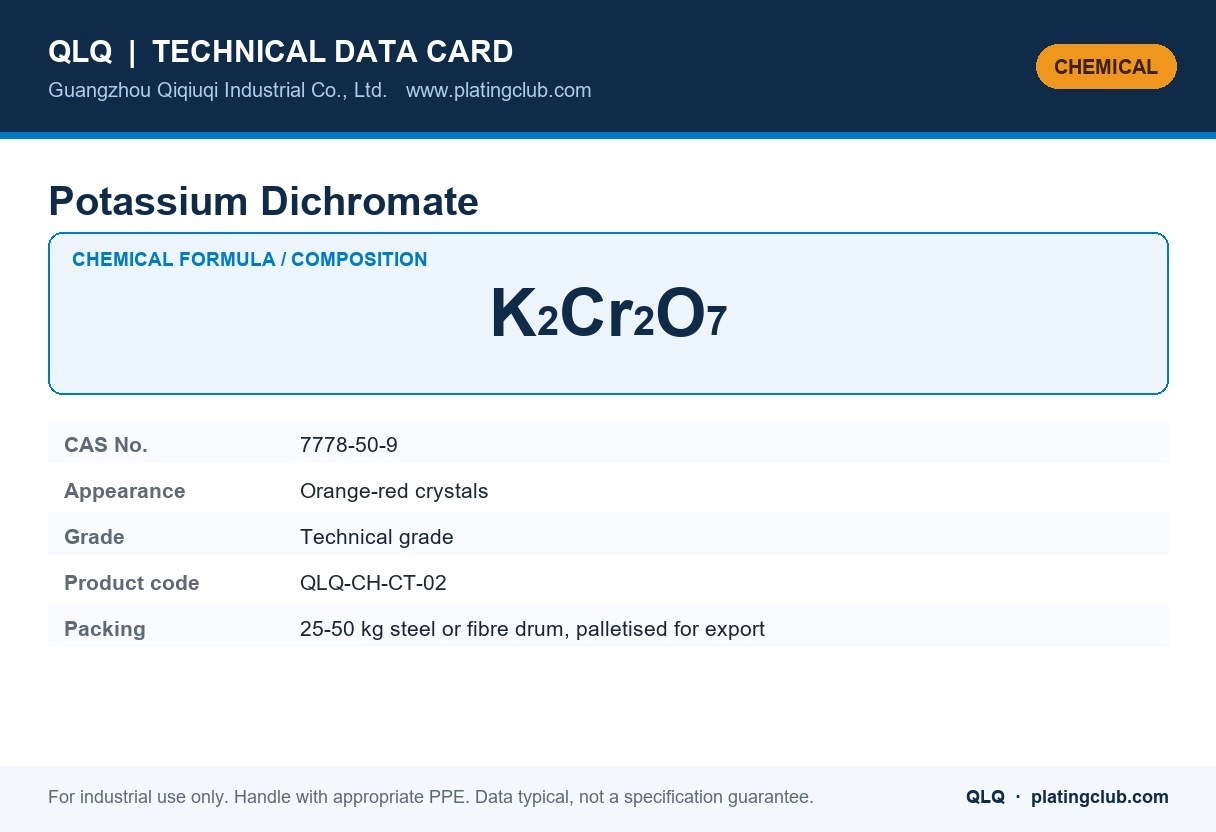
| Chemical name | Potassium Dichromate |
| Chemical formula | K2Cr2O7 |
| CAS number | 7778-50-9 |
| Appearance | Orange-red crystals |
| Grade / type | Technical grade |
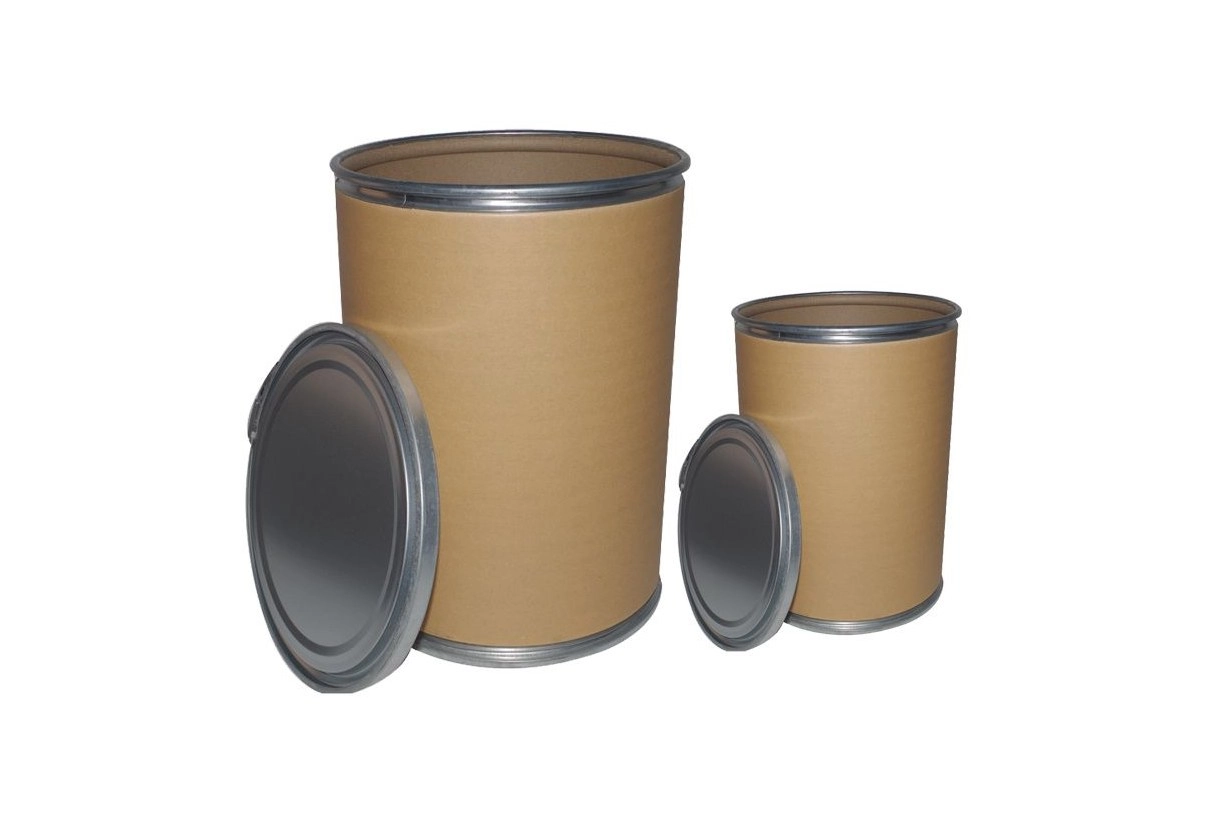
| Standard packing | 25-50 kg steel or fibre drum, palletised for export |
What it is and what it does. Potassium dichromate is the traditional chromate and passivation salt used for the chromate conversion coating of zinc and cadmium, and for the colouring and passivation of copper alloys.
- Orange-red crystals; the dichromate ion forms the protective chromate conversion film on zinc.
- Conventional hexavalent chromium chemistry, now increasingly replaced by trivalent passivates because of its carcinogenicity.
- It is an oxidiser as well as a chromate; storage must be separate from acids and combustibles.
Typical Use in a Plating / Finishing Line
| Item | Typical guidance |
|---|---|
| Zinc chromate conversion | 5-30 g/L with the appropriate acid addition, pH 1.5-3 at room temperature |
| Copper colouring | As specified by the colouring formulation |
| Analysis | Dichromate by iodometric titration |
Safety, Handling & Storage
| Item | Requirement |
|---|---|
| Hazard classification | Carcinogenic (GHS08) + corrosive + oxidising — strong sensitiser |
| Personal protective equipment | Full face shield, nitrile gloves, dust mask or respirator, coverall; closed handling to avoid dust |
| Spill / first aid | Collect dry where possible; reduce residues with sodium bisulfite solution, then treat as chromium-bearing waste |
| Storage | Sealed containers in a dry, locked store away from acids, reducing agents and combustible material; containment tray required |
| Transport | Classified and packed according to IATA/IMDG for the hazard class; UN number and packing group stated on the shipping documents |
Quality Documents Shipped With Every Batch
| Document | Comment |
|---|---|
| COA (certificate of analysis) | Provided with the shipment; batch traceable to the production date |
| MSDS (safety data sheet) | Provided with the shipment; batch traceable to the production date |
| Packing list | Provided with the shipment; batch traceable to the production date |
| Commercial invoice | Provided with the shipment; batch traceable to the production date |
| Certificate of origin on request | Provided with the shipment; batch traceable to the production date |
Buyer Questions We Answer Every Week
| Question | Answer |
|---|---|
| Can it be replaced? | Yes - trivalent chromium and chrome-free passivates are available, but the coating chemistry and the appearance differ. |
| What are the regulatory requirements? | Hexavalent chromium is a restricted substance in many markets; check the destination before quoting. |
| Item | Typical Value |
|---|---|
| Chemical formula | K2Cr2O7 |
| Assay | ≥ 99.5% |
| Appearance | Bright orange-red crystals |
| Solubility (20°C) | ~ 130 g/L in water |
| pH (5% solution) | ~ 4 |
| Chloride | ≤ 0.005% |
| Sulfate | ≤ 0.01% |
| Iron (Fe) | ≤ 0.005% |
| Water insoluble | ≤ 0.005% |
| Standard packing | 25KG woven bag with PE inner liner |
How to Check Quality Before Loading a Batch
| Check | Method | Pass Criteria |
|---|---|---|
| Appearance | Visual | Bright orange-red, free-flowing crystals; dull or black-tinted material is contaminated |
| Solubility / clarity | Dissolve 20 g in 100 ml DI water | Clear deep-orange solution; no residue |
| Assay | COA (iodometric titration) | ≥ 99.5%; reject below 99% |
| Chloride (corrosion-critical) | Silver nitrate test on a 5% solution | No heavy precipitate - chloride ruins chromate film performance |
| Panel test | Make a yellow-chromate dip at spec, treat a zinc-plated panel | Even yellow iridescence in the stated time; colour matches the retained reference |
How QLQ controls it: because this is a regulated substance, control starts before the salt arrives - every order is checked against end-use compliance, every lot is quarantined, assay-verified and panel-tested, and the COA plus batch record are kept for full traceability. QLQ also documents exactly what the material may and may not be used for under current regulations.
How It Works in the Line (Conversion, Sealing, Tarnish Control)
In an acidic dichromate dip the hexavalent chromium oxidises the zinc (or cadmium) surface while being itself reduced to a gel of trivalent chromium oxide containing residual hexavalent chromium - that mixed film is what gives yellow chromate its colour and its self-repairing corrosion behaviour: if the film is scratched, soluble hexavalent chromium in the film re-passivates the exposed metal. On anodized aluminium the dichromate seal works differently: it is a pore-closing hydration step in which dichromate is adsorbed into the porous oxide, giving the classic green-yellow tint and the best corrosion results of the classical seals. Baths are made up from the salt, acid and water; working data below are published ranges that must be tuned to the substrate, the required film weight and the applicable spec (for example the classical yellow chromate range on zinc).
| Application | Typical working data | Notes |
|---|---|---|
| Yellow (iridescent) chromate on zinc / cadmium | K2Cr2O7 3-10 g/L, mineral acid to pH 1.5-2.0, 15-30°C, 5-30 s immersion | Published range; proprietary accelerators modify it; film weight 0.2-1 g/m² |
| Olive-drab chromate (military-type) | K2Cr2O7 25-50 g/L with acid to low pH, longer dwell | Heavier greenish film, higher corrosion duty, for qualified specs |
| Dichromate seal of sulfuric-anodized aluminium | K2Cr2O7 45-60 g/L, pH 6-7, 90-96°C, 10-20 min | Classical seal; check spec - many programmes now require Cr-free seals |
| Tarnish-retardant dip for copper / brass | Dilute dichromate + acid, few g/L, short dip, then rinse and dry | Legacy practice; replace with benzotriazole-based systems where possible |
| Oxidizer / etch component (Cr plating, desmut) | Per proprietary recipe | Restricted in most export work; verify before any use |
Common Problems & Fixes (Workshop Table)
| Problem | Root cause | Fix |
|---|---|---|
| Pale, patchy yellow - no iridescence | Dichromate concentration low or pH too high; film dissolved back | Re-analyse and top up; correct pH to 1.5-2.0; shorten rinse after the dip |
| Brown or powdery film | Bath too strong, pH too low, or dwell too long | Dilute, raise pH slightly, cut immersion time |
| Poor corrosion test results | Chloride in water/salt, thin film, or poor rinsing leaving acid | Check chloride inputs; increase film weight; neutralise and dry properly |
| Anodize seal leaves streaks | Seal pH outside 6-7, temperature low, or parts crowded | Hold 90-96°C and pH 6-7; separate parts; verify seal time |
| Bath turns green (spent) | Hexavalent chromium reduced to green trivalent - normal consumption | Analyse and re-dose, or batch-replace when trivalent builds up |
Handling & Safety (Cr(VI) - Read This)
- Health: hexavalent chromium compounds are carcinogenic by inhalation and cause skin ulcers and allergic dermatitis. Never touch crystals with bare hands, never create dust, and keep all chromate tanks under extraction. Respiratory protection is mandatory where mist or dust is possible.
- PPE: dedicated gloves (nitrile/PVC), goggles or face shield, apron, and a respirator with P3/HEPA filters for powder handling. Change and decontaminate gloves after every shift; wash hands before eating.
- Dissolving: dissolve slowly in water with stirring; the solution is acidic and stains everything it touches. Use dedicated plastic tanks and tools - never wooden or woven materials that soak up chromium.
- Mixing: add acid to the dichromate solution carefully - the mixture heats; never add dichromate to hot concentrated acid.
- Waste - non-negotiable: hexavalent chromium must be reduced to trivalent (ferrous sulfate or metabisulfite at low pH) before precipitation, and the sludge handled as hazardous waste. Never discharge Cr(VI) to drain. Rinse water needs its own treatment loop and monitoring.
- Regulatory: confirm before ordering that the end use is lawful in the destination market (REACH authorisation/restriction, RoHS, ELV, defence exemptions where they apply). QLQ supplies documentation and restricted-use statements and will always propose trivalent or Cr-free systems where the spec allows.
What It Does on Iron, Zinc Alloy, Copper and Stainless Steel Parts
| Substrate | Role of the dichromate treatment | Recommended practice |
|---|---|---|
| Iron / steel parts | Not a direct finish on bare steel - its value is on the zinc or cadmium layer plated over steel; dilute dichromate rinses also give temporary in-plant rust inhibition | Chromate the plated zinc, never the steel; keep inhibitor rinses dilute and monitored |
| Zinc alloy / zinc-plated hardware | Yellow chromate converts the zinc surface into the classic corrosion-rated finish with self-healing film | Plate, bright-dip, chromate 5-30 s, rinse, dry warm; verify salt-spray hours against spec |
| Copper / brass | Legacy dilute chromate dips retard tarnish on polished brass and copper hardware | Short dip, superb rinsing, then lacquer; switch to benzotriazole systems for export goods |
| Stainless steel | No role - stainless is passivated by its own chromium oxide, and chromate treatments add no value while adding Cr(VI) compliance burden | Passivate with citric or nitric systems instead; keep stainless out of chromate tanks |
FAQ
| Question | Answer |
|---|---|
| Is hexavalent chromate still legal to use? | It depends on the market and the part. The EU restricts hexavalent chromium in most articles and requires authorisation for many uses; defence and some industrial applications carry exemptions. Always confirm destination-market law and the customer's spec before chromating. |
| Why is yellow chromate still specified if it is restricted? | Its corrosion performance and self-healing film remain excellent and some long-qualified specs still require it. Where the spec is not locked, trivalent passivates now cover most zinc work with far lighter compliance - QLQ supports both routes. |
| How do I control my chromate bath strength? | Titrate hexavalent chromium (iodometric or diphenylcarbazide colorimetric) daily, log time-to-colour on a test panel, and watch for the green tint that signals trivalent build-up. Re-dose or replace before colour drifts. |
| How does QLQ handle the compliance side? | Every shipment carries COA, SDS and a restricted-use statement, batches are fully traceable, and QLQ engineers advise on trivalent or Cr-free alternatives whenever the application allows a switch. |
Chromating or sealing questions? Tell QLQ your substrate, finish spec and destination market - engineers recommend the compliant route (hex or trivalent) and help tune the bath. Contact us.
Shipping cost is based on weight. Just add products to your cart and use the Shipping Calculator to see the shipping price.We want you to be 100% satisfied with your purchase. Items can be returned or exchanged within 30 days of delivery.