

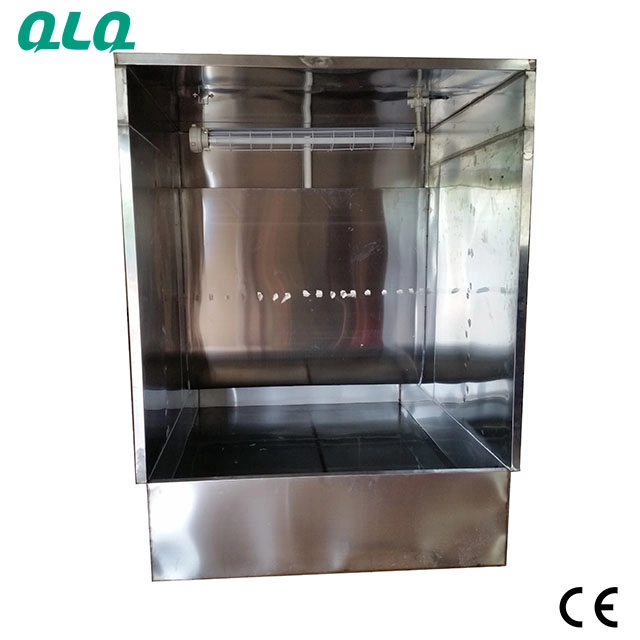
Black tumble painted parts left the drum with grey, thin edges while the flats looked fine, and the customer rejected the batch for color. The drum was rotating at 22 rpm, so each part crossed the spray zone too fast to build film on its edges.
This intermediate guide tunes the two variables that fixed it: drum speed at 8-15 rpm for small parts and spray cycle time matched to the drum volume, with a film target of 20-40 µm checked per position.

Common Mistakes and How to Avoid Them
| Mistake | Why It Happens | Practical Fix |
|---|---|---|
| 1. Drum too fast | Parts skip the spray zone | Set 8-15 rpm per part |
| 2. One heavy pass | Edges thin, flats heavy | Two light passes per cycle |
| 3. Cycle too short | Film below target | Match cycle to drum volume |
| 4. Gun distance wrong | Over-spray dust on edges | Set distance per gun spec |
| 5. Film not measured | Grey edges found at QC | Measure per position |
| 6. Over-spray dust | Dry dust lands on wet film | Improve extraction and distance |
| 7. Same cycle for all parts | Different geometry, different film | Cycle per part group |
| 8. Rotation not checked | Parts pile in the drum | Verify tumbling action |
| 9. Solvent drift | Viscosity changes mid-shift | Check Ford cup per batch |
Best Practices
- Set drum speed at 8-15 rpm and verify rotation
- Build film in two light passes, not one heavy one
- Match spray cycle time to drum volume and part
- Measure film thickness per position per batch
- Check viscosity per batch to hold the window
- Clean extraction to stop over-spray dust
Implementation Roadmap
| Step | Frequency |
|---|---|
| Rotation and speed check | Per batch start |
| Spray cycle time | Per part group |
| Film measurement | Per batch, per position |
| Viscosity check | Per batch |
| Extraction and drum clean | Per shift |
Even film tuning flow
- Set speed - 8-15 rpm, verified rotation. (Fast drums thin the edges.)
- Tune cycle - Cycle per drum volume, two passes. (One heavy pass starves edges.)
- Measure - Film per position, 20-40 µm. (Grey edges hide until QC.)
- Adjust and log - One variable, then record. (Unlogged changes repeat next week.)
Edge film builds when parts cross the spray zone slowly and often. | Over-spray dust dries on the film and reads as grey roughness.
Spray tuning data
Reference values for tumble painting film control.
| Parameter | Reference | Why It Matters |
|---|---|---|
| Drum speed | 8-15 rpm for small parts | Fast drums thin edges |
| Spray cycle | Per drum volume | Short cycles under-build film |
| Film target | 20-40 µm dry film | Thin edges read grey |
| Passes | Two light passes | One heavy pass starves edges |
| Gun distance | Per gun spec, 20-30 cm | Wrong distance makes dust |
| Viscosity | 15-25 s Ford #4 | Drift changes film build |
| Flash and cure | Per paint spec | Holds the film that was built |
Spray cycle tune card
| Part group | Drum speed | Cycle time | Film target |
|---|---|---|---|
| Small fasteners | 10-12 rpm | 60-90 s | 25-35 µm |
| Knobs and handles | 8-10 rpm | 90-120 s | 25-35 µm |
| Flat washers | 12-15 rpm | 45-60 s | 20-30 µm |
Edge defect map
| Symptom | Cause | First fix |
|---|---|---|
| Grey edges | Drum too fast | Slow to 8-15 rpm |
| Grey edges | Cycle too short | Extend cycle |
| Rough grey | Over-spray dust | Extraction, distance |
| Patchy film | Piling in drum | Check rotation |
| Dark flats | One heavy pass | Two light passes |
Case 1 - grey edges on black slider parts
Scenario. A plant's black tumble painted sliders showed grey edges on 30 percent of parts; the drum ran at 22 rpm and the spray cycle lasted 40 seconds.
Action. Drum speed was dropped to 12 rpm, the cycle was extended to 90 seconds and the film was built in two light passes; film was then measured at flats and edges per batch.
Result. Edge film rose from below 10 µm to 28-32 µm, grey edges disappeared and the reject rate fell to under 1 percent.
Case 2 - thin edges on zinc die-cast knobs in Europe
Scenario. A European customer rejected die-cast knobs for light edges after a line speed increase; the same cycle time was still running on heavier parts.
Action. Cycle time was set per part group and a position-based film check was added for the knob batch.
Result. Edge coverage passed the 25 µm minimum and the reject dispute closed with the film record.
Frequently Asked Questions
Why are edges grey on black parts?
Edges build less film than flats when parts cross the spray zone too fast or the cycle is too short.
What drum speed works?
About 8-15 rpm for small parts; verify that parts actually tumble, not pile.
How long should the spray cycle run?
Long enough to reach 20-40 µm film; it scales with drum volume and part geometry.
Why two light passes?
Two light passes cover edges evenly; one heavy pass starves them.
How do I check film thickness?
Measure dry film at flats and edges with a gauge per position per batch.
What is over-spray dust?
Dry paint dust that lands on wet film and reads as grey roughness on edges.
Why measure per position?
Film varies around the drum; one reading hides the thin zone.
Should I change speed and cycle together?
No - change one variable per trial and log the result.
What if film passes but edges look grey?
Check viscosity and extraction; both change film appearance without thickness.
What Would You Like to Solve?
Describe your drum speed, spray cycle and the edge pattern you see; the tuning steps above can be applied to your line as they are.