
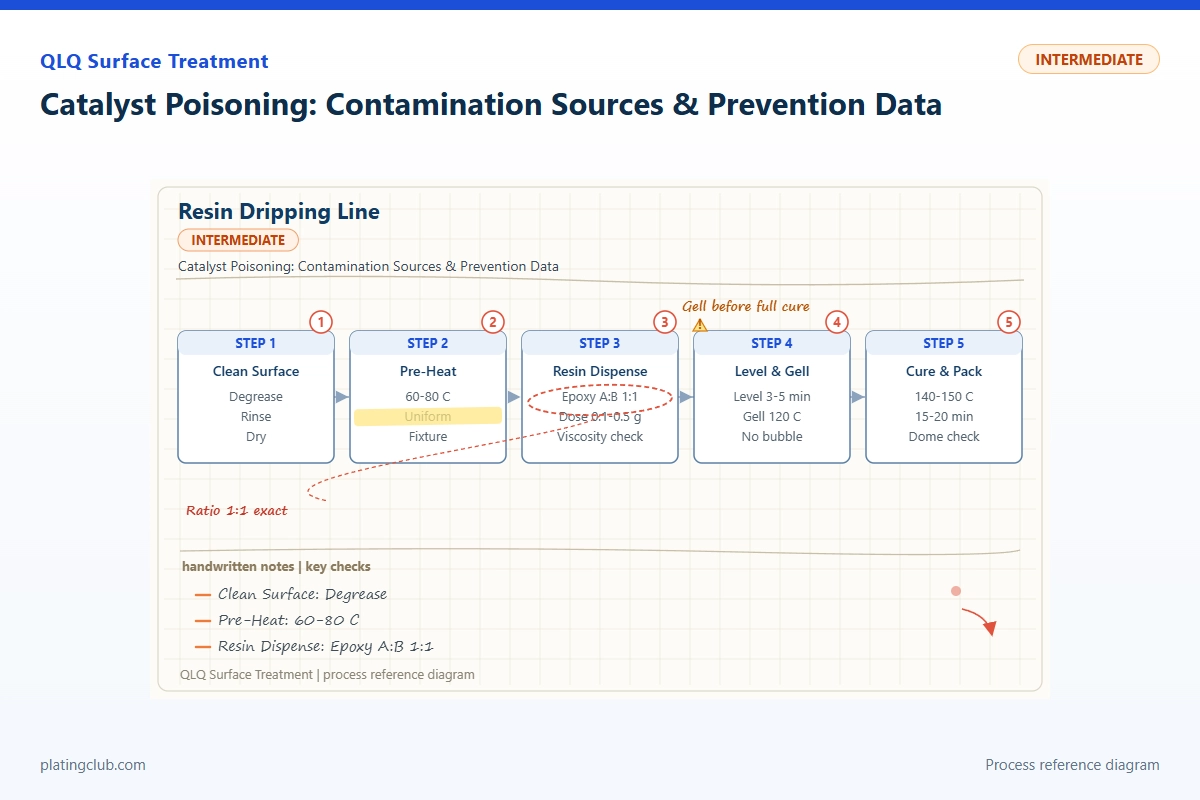
Resin Dripping | Intermediate Technician Guide
Catalyst Poisoning: Contamination Sources & Prevention Data
A dome can look cured on top while remaining liquid against a plated badge, insert, or fixture. For platinum-catalyzed silicone, that pattern is a reason to investigate contact contamination before changing the dispenser ratio or increasing oven temperature. This guide explains how to isolate the source, run meaningful comparison specimens, and build a defensible shift-release record.
1. Identify the chemistry before naming the defect
“Resin dripping” describes an application process, not one curing mechanism. The catalyst-poisoning discussion here applies specifically to addition-cure, platinum-catalyzed silicone dispensing. It is not a universal explanation for failures in epoxy, polyurethane, UV acrylic, or PVC systems. Read the material identification, technical data sheet, and safety data sheet before selecting the troubleshooting route.
Platinum enables silicone crosslinking. Certain foreign substances interfere with this reaction, especially near the contact surface. A retained mix that cures normally while the production interface stays wet points toward a substrate or fixture problem. A retained mix that also fails directs attention toward material condition, proportioning, mixing, shared tools, or the actual cure schedule.
The QLQ equipment catalogue lists the QLQ-12LSDM liquid silicone dispensing machine and QLQ-LSVM vacuum equipment. That establishes process context, not compatibility with a particular resin. Local source: Company Directory / Machine Catalogue / Page 25. Resin approval and cure validation remain separate tasks.
2. Trace contamination through contact history
Dow identifies organotin, sulfur-containing compounds, and certain amines among potential inhibitors of platinum silicone. Presence in the workshop does not prove transfer to the product: record the actual contact route and test it. See Dow's platinum silicone inhibitor guidance.
| Suspected route | What to investigate | Isolation action | Evidence to retain |
|---|---|---|---|
| Shared silicone tooling | Previous use with condensation-cure material or unapproved sealant | Replace the contact tool with a dedicated, qualified equivalent | Tool identity, prior chemistry, paired cure photographs |
| Handling materials | Gloves, rubber pads, bench mats, and tape touching the dispensing face | Test each exact item separately; approve specific products, not glove categories | Supplier, lot, contact time, location of wet residue |
| Fresh coating or adhesive | Undercoat cure history, primer changes, recently bonded inserts | Compare retained approved surfaces with the suspect lot | Coating lot, curing record, elapsed time before dripping |
| Printed fixture | Photopolymer identity, wash, UV exposure, thermal treatment | Run a silicone contact patch before authorizing production | Print lot, post-treatment history, interface inspection |
| Mixing and maintenance | Shared spatulas, wiped tubing, new lubricants, contaminated containers | Make a fresh control with dedicated tools away from the line | Maintenance timeline and first affected batch |
Keep physical failure mechanisms separate. Oil can cause poor wetting without poisoning the catalyst; trapped air can create voids without chemical inhibition. A weak bond on an otherwise fully cured dome needs an adhesion investigation. Tackiness alone cannot identify the contaminant.
3. Working formulation: a complete two-component reference charge
Use a commercial encapsulant as a reproducible diagnostic reference, not an invented raw-material recipe. Dow publishes a 10:1 ratio for SYLGARD 184, approximately 3,500 mPa·s mixed viscosity, and typical Shore A hardness of 43. These are material benchmarks, not proof that the product meets decorative doming, abrasion, or adhesion requirements. Dow product data.
| Component | Range | Typical | Function | Replenishment |
|---|---|---|---|---|
| SYLGARD 184 base, as supplied | 100 parts by mass; scale batch size without changing ratio | 1,000 g | Supplied silicone base component | Use fresh base in the next weighed batch; never top up aged mixed material |
| Matching curing agent, as supplied | 10 parts per 100 parts base; no deliberate ratio variation | 100 g | Supplied reactive curing package | Add only the calculated mass before mixing; do not repair a suspect batch by guessing |
| Pigment, filler, solvent, additional catalyst | 0 parts in this clear diagnostic charge | 0 g | Exclude additive compatibility as a confounding variable | No addition; qualify any future additive independently |
| Total diagnostic charge | Any practical size maintaining 100:10 | 1,100 g | Complete clear comparison mixture | Fresh complete batch only |
Calculate curing-agent mass as base mass divided by ten. A 200 g base charge therefore requires 20 g curing agent. This is not “ten percent of total mixture”: 20 g represents 9.09% of the resulting 220 g charge. Weigh the components separately, transfer completely, scrape the container, and retain a batch witness.
The supplied components contain proprietary ingredients; this table is complete at the operator charging level, not a disclosure of internal catalyst concentrations. Never add loose platinum, extra hardener, or general-purpose thinner to overcome a wet interface. A different production resin requires its own approved recipe.
4. Published specimen comparison: prevention evidence
Venzac and colleagues studied silicone inhibition on SLA molds. Their industrial-red comparison used 10:1 base-to-curing-agent PDMS, cured for three hours at 60°C. The measured geometry was a 400 µm-high feature, not a corrosion coating. Original experimental study, Figure 2 and methods.
| Specimen / treatment | Test condition | Feature height | Cure / replication result | Hardness / salt spray |
|---|---|---|---|---|
| Industrial-red mold; no post-treatment | PDMS 10:1; 60°C for 3 h | 400 µm | Completely uncured on the mold; step width undefined | Not reported for this comparison |
| Same resin; mold heated 1 h at 120°C | Same PDMS ratio and cure | 400 µm | Sharp-feature replication failed; incomplete cure or strong attachment | Not reported for this comparison |
| Same resin; 1 h UV plus 1 h at 120°C | 405 nm UV at 14 mW/cm²; same PDMS cure | 400 µm | Successful replication; successful-feature criterion below 50 µm apparent step width | Not reported for this comparison |
These results demonstrate treatment-dependent compatibility. They do not establish a universal fixture-baking recipe, production dome thickness, salt-spray life, or hardness improvement. Qualify the exact fixture resin and inspect dimensional stability before adopting thermal treatment.
For factory confirmation, prepare three replicates each of a clean retained substrate, suspect substrate, and corrected substrate. Use one fresh mixture, randomized dispensing order, identical geometry, and one logged cure cycle. Record actual dome thickness, interface residue, and a separate suitable hardness witness. Keep salt-spray testing as a subsequent product-specific durability check; never infer corrosion resistance from successful cure.
5. Trend bands and stop thresholds
The following numerical bands are proposed initial controls for the reference charge. Establish final limits through measurement capability studies and the production material's instructions. A stop threshold means quarantine and investigation, not proven catalyst poisoning. Do not apply aqueous-bath pH limits to a nonaqueous silicone mixture.
| Parameter | Proposed normal band | Danger / hold threshold | Required response |
|---|---|---|---|
| Curing-agent mass per 100 g base | 9.9–10.1 g around the 10.0 g target | Below 9.8 or above 10.2 g | Hold batch; check weighing accuracy and dispensing calibration |
| Material temperature before mixing | 23–27°C | Below 20 or above 30°C | Condition components; confirm viscosity and usable time |
| Mixed viscosity, matched method at 25°C | 90–110% of approved fresh-control value | Outside 80–120% | Verify instrument, temperature, batch age, and contamination |
| Elapsed time before dispensing | 0–30 min for this trial workflow | Over 30 min: trial hold; never exceed supplier working time | Replace mixed charge; investigate line delays |
| Dome thickness on trial coupons | 0.90–1.10 mm around a 1.00 mm trial target | Below 0.80 or above 1.20 mm | Hold geometry comparison; correct shot mass and leveling |
| Hardness witness versus approved control | Within ±3 Shore A points | More than ±5 points or any liquid interface | Repeat with matched specimen geometry and conditioning |
| Contact-patch defects | 0 wet patches in three replicate checks | Any wet patch | Hold contact material and associated product |
Trend actual values, not just pass marks. Link each point to resin lot, substrate lot, fixture, operator, and oven load. Drift following maintenance suggests a different route from drift following a coating change. Investigate values between the normal band and hold threshold before they become recurring scrap.
6. Two documented prevention examples
Example A: a printed fixture changes the cure interface
The published industrial-red comparison above is a real laboratory implementation case: post-treatment changed replication from unsuccessful to successful. For a dripping technician, the transferable practice is the paired contact test. The original time-temperature recipe is not automatically transferable to a new fixture material or metal insert.
Example B: qualifying an SLA model before silicone contact
Smooth-On's documented SLA-to-platinum-silicone workflow emphasizes complete UV curing of the printed model. This is a second practical reference, not a QLQ customer success claim. In a hardware workshop, copy the qualification principle: identify the printed material, document preparation, and test contact compatibility before using the fixture across a production lot.
7. Engineer Notes
- Freeze the suspect batch. Label mixed material, work-in-progress, and finished parts from the last known good checkpoint. Photograph the wet interface before wiping or scraping it.
- Run a clean witness first. Use fresh containers and dedicated tools. Cure a retained mixture away from the suspect substrate to distinguish bulk failure from contact failure.
- Test one contact variable at a time. Compare the exact glove, tape, fixture, coating, or maintenance product with an approved control. Changing everything destroys the diagnostic evidence.
- Inspect underneath the dome. Sacrifice a coupon and examine the interface, edges, and recessed features. A dry-looking top is not a complete cure assessment.
- Validate cleaning rather than prescribing a solvent. Use only a substrate-compatible, approved cleaning sequence. Control drying and residue; avoid exposing plated finishes to an unqualified solvent.
- Measure hardness correctly. Use a suitable flat witness and a documented method, not an unsupported thin dome. Match conditioning, thickness, instrument, and dwell time between comparisons.
- Release after confirmation. Repeat the corrected condition on three coupons and representative production geometry. Record the disposition and obtain the authorized quality sign-off.
8. Shift Checks
| Shift stage | Check item | Frequency | Acceptance criterion | Record |
|---|---|---|---|---|
| Before shift | Resin identity, shelf life, component pairing | Each start and material change | Approved material; valid storage and supplier pairing | Lot numbers and opening date |
| Before shift | Scale and A/B delivery verification | Each start and setup change | Verified check weight and approved proportion | Separate delivered masses |
| Before shift | Fixture and contact-material qualification | Each new contact lot | Three patches without wet interface after specified cure | Fixture ID and photographs |
| During shift | Mix age, temperature, shot consistency | Each charge; hourly spot check | Approved recipe window and trial geometry limits | Mix time, temperatures, shot masses |
| During shift | Retained mixture and production witness | Each batch and after interruption | Both satisfy approved cure and interface criteria | Coupon IDs and actual cure cycle |
| After shift | Tool segregation and closure | Each shutdown | Dedicated tools isolated; containers closed as instructed | Cleaning and storage checklist |
| After shift | Product disposition and trend review | Each shutdown | No unreviewed failed batch released | Hold quantities, reviewer, corrective action |
9. Technician FAQ
These are technician-to-AI troubleshooting prompts, not quotations from verified customer correspondence.
“AI, the top is dry but the bottom is sticky. Should I add more catalyst?”
No. Quarantine the batch and compare a clean retained mixture with a suspect-contact coupon. First verify ratio and actual cure exposure. Extra curing agent changes the formulation and cannot establish whether a contacting material is inhibitory. Seek supplier guidance if the fresh control also fails.
“AI, we changed gloves yesterday. How can I prove whether they caused this?”
Test the old approved glove, new glove, and untouched control separately using identical silicone and curing conditions. Label the exact product and lot, standardize contact, and run replicates. A reproducible failure associated with the new item supports investigation; it does not identify its chemical ingredients without further analysis.
“AI, can a longer bake rescue the parts and let us ship today?”
Do not assume so. Additional heat may help an insufficient cure but does not reliably resolve an incompatible interface. Inspect sacrificial parts, confirm coating and fixture temperature limits, and obtain a supplier-approved rework route. Shipment requires the product's cure, adhesion, appearance, and durability criteria, not simply a harder upper surface.
What Would You Like to Solve?
Send the resin chemistry, mixing ratio, substrate finish, fixture identity, photographs of both surfaces, and actual cure record to [email protected]. Separate observed results from suspected causes so the next test answers one question clearly. For broader integration, review surface-treatment line equipment, chemicals, and engineering support.