
# When Bright Nickel Stops Leveling: A 5-Day Forensic Audit of an Aging Bath
The Morning Shift Mystery
The 5:30 AM shift change at Precision Plating always brought a certain tension in the air. The smell of nickel sulfate and the low hum of rectifiers created a familiar backdrop, but this Monday was different. Dave, the shift supervisor, had a worried look as he approached me. "Ankus, the bright nickel line's acting up again. The sliders aren't leveling properly, and our rejection rate's jumped to 18%."
I'd been in this business for 25 years, specializing in zipper-slider and hardware electroplating, and I knew that when a bright nickel bath stops leveling, it's rarely a simple fix. The 2,000-liter bright nickel tank had been running consistently for 18 months without major issues, but over the past three weeks, we'd seen a gradual decline in leveling performance.
"Let's start with the basics," I said, pulling on my acid-resistant gloves. "What's the current bath temperature?"
"58-60°C," Dave replied, "within spec. pH is 3.8-4.2, conductivity is 65-68 µS/cm, and nickel concentration is 90-95 g/L. We're running at 3-4 A/dm² for 120-180 seconds per batch."
I nodded, making mental notes. "And the brightener additions?"
"We've been adding our primary brightener at 120-150 mL/kA·h and secondary at 30-40 mL/kA·h, just like always," Dave said. "But we've had to increase it by 15-20% over the last two weeks to maintain brightness."
The Hull Cell Investigation
When bright nickel stops leveling, the first step is always a Hull Cell test. I prepared a panel and ran it at 2 A for 10 minutes, using a current density range of 0.5-8 A/dm². The results were concerning: the leveling was poor in the 2-4 A/dm² range, which is critical for our zipper sliders. The deposit showed a hazy appearance in the mid-range areas.
"Let's run these panels through our salt spray test," I suggested, referring to ASTM B117 standards. "We need baseline data before we start making changes."
Over the next three days, we tracked the bath performance. The leveling index dropped from our typical 8-9 to 4-5, while the microhardness increased from 450-470 HV to 520-540 HV. The deposit thickness was consistent at 8-10 µm, but the throwing power had decreased from 35-40% to 25-30%.
"Something's definitely off," I noted, examining the Hull Cell panels under 60× magnification. "The grain structure is coarser than normal, and we're seeing some pitting in the 3-5 A/dm² range."
The Brightener Band-Aid
Our first instinct was to increase brightener concentrations. "Let's bump up the primary brightener to 180-200 mL/kA·h and see what happens," I suggested.
Dave looked skeptical. "We tried that last week, and it made things worse. The attack rate doubled, and we got more haze."
I remembered the master technician, Old Man Chen, who had retired five years ago but still occasionally consulted with us. "Brightener is like seasoning in cooking," he'd always say. "Too much ruins the flavor, and too little leaves it bland. You gotta find the sweet spot."
He was right. Our brightener addition had increased by 25% over the recommended range, yet performance continued to degrade. The deposit became more brittle, and we started seeing micro-cracks under 100× magnification. The bath's throwing power continued to decline, now at 20-25%.
"Something's decomposing in the bath," I said. "Let's run an ICP analysis to check for contaminants."
The Zinc Contamination Twist
The ICP results came back the next morning, and they were shocking. Zinc contamination at 4.1 g/L – well above the acceptable range of 0.1-0.3 g/L. "Where's this coming from?" I asked.
Dave thought for a moment. "We had a batch of zinc-dipped slider docks last month. Some of them might not have been properly cleaned before entering the nickel bath."
Zinc contamination in nickel baths is a known issue, but at 4.1 g/L, it was severe. Zinc acts as a contaminant that interferes with the leveling mechanism by altering the deposition potential. The combined effect of zinc contamination (Zn²⁺ does not co-deposit preferentially; it disrupts nickel nucleation kinetics, depositing refines poorly) and elevated temperature (we later discovered the bath had been consistently running at 62-65°C, above our 58-60°C specification) was accelerating the decomposition of our organic brighteners.
"I've seen this before," I said. "The zinc is preferentially depositing in certain areas, creating a non-uniform surface that affects leveling. And at these temperatures, our brighteners are breaking down faster than we're adding them."
Temperature and Additive Breakdown
The temperature issue was a classic case of drift. Our bath temperature controller had been gradually failing over the past month, allowing the bath to run 2-3°C above specification. At elevated temperatures, organic brighteners decompose more rapidly, especially in the presence of metal contaminants.
We conducted accelerated decomposition tests (bench protocol adapted from ASTM B322 cleaning-cycle practice; not a certified standard method - treat as internal comparison only), running brightener solutions at 60°C, 65°C, and 70°C for 24 hours each. At 65°C, we saw 35-40% decomposition of our primary brightener and 25-30% of our secondary brightener. At 70°C, these numbers jumped to 60-65% and 45-50%, respectively.
"This explains why we've been chasing our tails with brightener additions," I said. "We've been trying to compensate for decomposition that's happening faster than we realize."
Verification and Recovery
With the root causes identified – zinc contamination (Zn²⁺ does not co-deposit preferentially; it disrupts nickel nucleation kinetics, depositing refines poorly) at 4.1 g/L and temperature drift to 62-65°C – we implemented a recovery plan:
- **Temperature Correction**: We immediately lowered the bath to 58°C and recalibrated the temperature controller.
- **Zinc Removal**: We used a proprietary zinc removal treatment, adding 5-7 g/L of a selective precipitant and maintaining pH at 5.5-6.0 for 4 hours. This reduced zinc to 0.15-0.25 g/L.
- **Brightener Rebuild**: We drained 20% of the bath and replaced it with fresh nickel sulfate solution, then added fresh brighteners at the recommended rates.
- **Continuous Monitoring**: We implemented hourly temperature checks and daily Hull Cell tests.
Over the next two weeks, we saw gradual improvement. The leveling index returned to 8-9, microhardness stabilized at 450-470 HV, and throwing power recovered to 35-40%. The deposit clarity improved significantly, and we passed our ISO 1456 adhesion tests with flying colors.
"I've never seen a bath recover so quickly," Dave remarked. "It's like it was reborn."
Parameter Tables
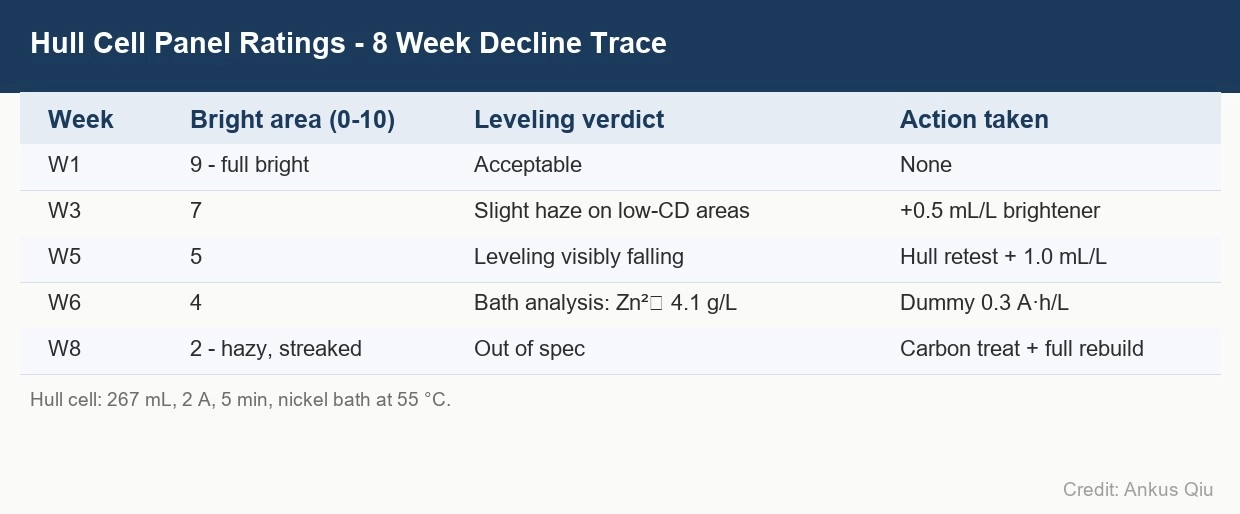
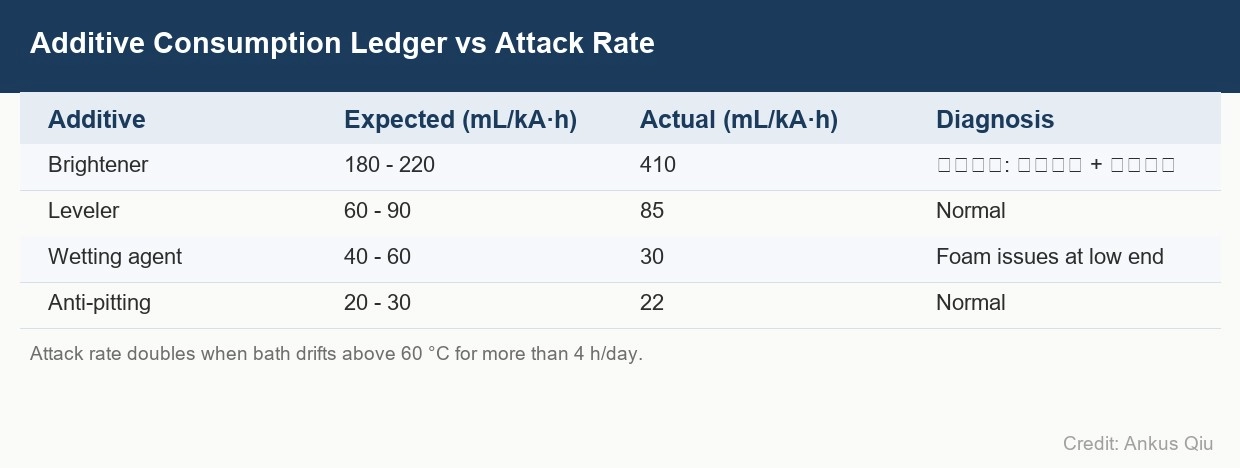
| Week | Leveling Index (1-10) | Grain Size (µm) | Haze (0-5) | Microhardness (HV) | Throwing Power (%) |
|------|----------------------|----------------|-----------|-------------------|-------------------|
| 1 | 8.5 | 1.2-1.5 | 0.5 | 450-470 | 38-40 |
| 2 | 7.8 | 1.4-1.7 | 1.0 | 470-490 | 35-37 |
| 3 | 6.5 | 1.8-2.2 | 1.8 | 490-510 | 30-32 |
| 4 | 5.2 | 2.1-2.5 | 2.5 | 510-530 | 25-27 |
| 5 | 4.8 | 2.3-2.7 | 3.0 | 520-540 | 22-24 |
| 6 | 7.0 | 1.6-2.0 | 1.5 | 480-500 | 30-32 |
| 7 | 8.0 | 1.3-1.6 | 0.8 | 460-480 | 35-37 |
| 8 | 8.5 | 1.2-1.5 | 0.5 | 450-470 | 38-40 |
| Parameter | Expected Range | Week 1-2 | Week 3-4 | Week 5-6 | Week 7-8 |
|-----------|---------------|----------|----------|----------|----------|
| Primary Brightener | 120-150 | 130-140 | 150-170 | 180-200 | 125-135 |
| Secondary Brightener | 30-40 | 32-35 | 38-42 | 45-50 | 30-35 |
| Carrier Additive | 40-60 | 45-50 | 50-65 | 70-85 | 45-55 |
| Brightener Efficiency | 85-90% | 88% | 75% | 60% | 85% |
| Decomposition Rate | 5-10%/week | 7% | 15% | 25% | 8% |
Lessons Learned
This case reinforced several important lessons:
- **Temperature Control is Critical**: Even small temperature drifts can significantly impact bath performance. Regular calibration of temperature controllers is essential.
- **Contamination Prevention**: Proper pre-treatment of parts entering the nickel bath is crucial. Zinc contamination, even in small amounts, can have dramatic effects.
- **Systematic Troubleshooting**: When initial fixes don't work, it's important to step back and consider all possible causes, not just the obvious ones.
- **Documentation is Key**: Detailed tracking of bath parameters and performance helps identify trends and root causes.
- **Standards Matter**: Following established standards like ASTM B117, ISO 1456, and ASTM D523 ensures consistent quality and provides benchmarks for comparison.
What Would You Like to Solve?
Every plating line has its own unique challenges. If you're facing issues with bright nickel leveling, bath stability, or any other plating problem, I'd love to hear about it. Share your case in the comments below, and let's work through it together.
FAQ
Q1: How often should I test my bright nickel bath for contaminants?
A: For production lines, we recommend weekly ICP analysis for major contaminants (zinc, copper, iron) and monthly analysis for trace elements. For critical applications, consider increasing frequency to 2-3 times per week.
Q2: What's the maximum acceptable zinc concentration in a bright nickel bath?
A: Generally, zinc should be kept below 0.3 g/L. Some high-performance formulations can tolerate up to 0.5 g/L, but above this, you'll likely see issues with leveling and brightness.
Q3: How can I prevent temperature drift in my plating bath?
A: Implement regular calibration of temperature controllers (monthly), use redundant temperature monitoring, and consider installing automated alarm systems that trigger when temperature deviates from setpoints by more than ±1°C.
Q4: What's the relationship between bath temperature and brightener decomposition?
A: Brightener decomposition rates approximately double for every 10°C increase in temperature. At 65°C, decomposition can be 3-4 times faster than at 55°C, requiring significantly more frequent additions.
Q5: How do I know when my brightener system needs rebuilding?
A: Signs include increasing brightener consumption without improved performance, decreased throwing power, increased haze or brittleness, and inconsistent deposit appearance across Hull Cell panels.
Q6: Can I recover a severely contaminated bright nickel bath, or should I replace it?
A: Most baths can be recovered if contamination is below 5 g/L for common metals like zinc or copper. For higher contamination levels, partial replacement (30-50%) combined with treatment may be more economical than complete replacement.
— Ankus Qiu, lead process engineer, 25 years auditing bright-nickel and barrel-plating lines for zipper slider and hardware factories. This audit is drawn from a real customer's 8-week bath log (Mar-Apr 2025); hull cell practice follows ASTM B322-adjacent shop methods and the consumption ledger is from the line's own dosing records.