
When a factory owner asks "how much do chemicals cost per year?", the answers they usually get are either a guess or a sales pitch. This guide gives the actual calculation our engineers walk through with line owners — the two consumption tracks, the working formula, the real-world proportions, and the one maintenance habit that swings annual chemical cost by 20% or more.
The Two Consumption Tracks
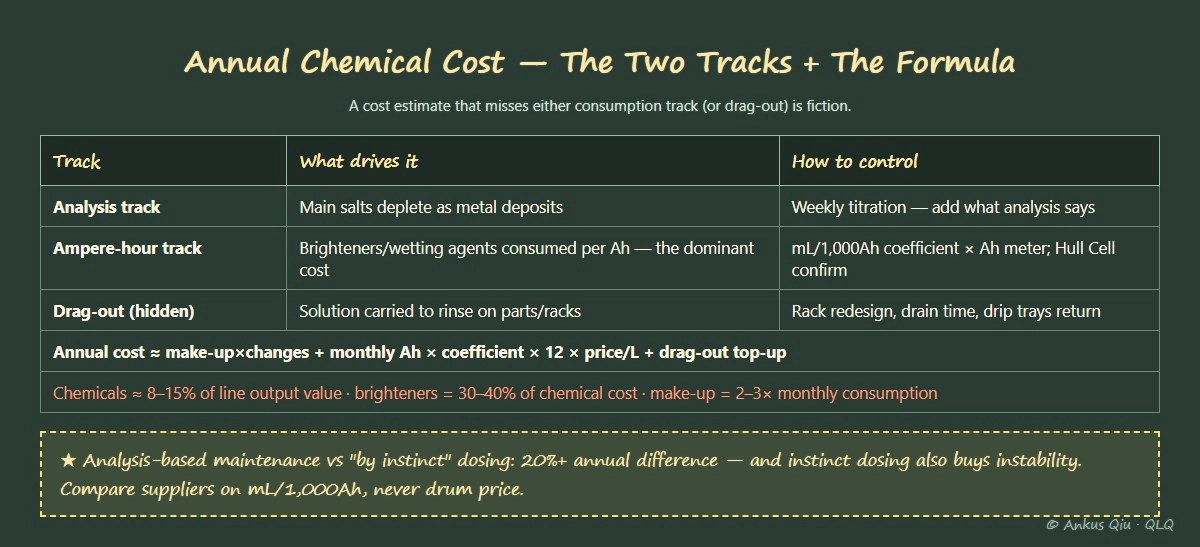
Plating bath chemicals are consumed on two independent tracks, and a cost estimate that misses either one is fiction:
Track 1 — Bath analysis consumption (replenishment by titration).
Main salts (nickel sulfate, zinc, copper sulfate) deplete as metal deposits, and are corrected by weekly analysis titration: what the analysis says is low, you add. This track is predictable and small once the bath is at volume.
Track 2 — Ampere-hour consumption (additives by Ah).
Brighteners, wetting agents, and organic additives are consumed by the electric charge passing through the bath — roughly a fixed number of milliliters per ampere-hour (mAh/Ah coefficient, calibrated by your chemical supplier). At production scale this track is the dominant cost, and it is exactly why two shops running the same bath chemistry can have very different annual bills: the one running higher amperage-hours consumes proportionally more additive.
Track 3 (the hidden one) — drag-out.
Every part that leaves the tank carries bath solution to the rinse. Wide racks, bad drainage, and fast withdrawal raise drag-out dramatically, and the bath volume must be topped up — with chemistry — to compensate. Drag-out is why the same line in two factories can differ 30%+ in chemical consumption before any chemistry difference at all.
The Working Formula
Annual chemical cost ≈ (make-up volume × make-up cost × changes per year) + (monthly Ah × additive consumption coefficient × cost per liter × 12) + (drag-out replacement estimate)
Worked example, bright nickel barrel line (illustrative structure — your supplier's coefficients and local prices govern):
- Bath: 2,000 L at make-up
- Production: ~40,000 Ah per month
- Brightener coefficient (typical order of magnitude, supplier-calibrated): 100–200 mL per 1,000 Ah
- Annual brightener volume = 40,000 × 0.12 × 12 ≈ 57,600 mL ≈ 58 L — times your price per liter
Add main-salt top-ups from weekly analysis, wetting agent by its own coefficient, and drag-out top-up, and you have the number. Suppliers who refuse to give you the mL/1000Ah coefficient are suppliers who want to invoice by feel.
The Proportions to Expect
From our line data across zipper hardware shops:
- Chemicals run about 8–15% of the line's output value annually (the rest is labor, energy, depreciation, water treatment)
- Within chemical cost, brighteners and organic additives take 30–40% — the small drums cost more per year than the big sacks of salts
- Make-up (first fill) is typically 2–3× the monthly consumption — plan working capital accordingly
The Habit That Saves 20%+
Two shops, same chemistry, same parts. One tops up additives "by the look of the deposit and the shift supervisor's instinct". The other tops up by amp-hour meter and confirms weekly with a Hull Cell panel. Year for year, the instinct shop spends 20% or more on chemicals — and gets unstable deposit quality in exchange, because over-added brightener behaves as an organic contaminant (pitting, haze, brittleness) and then needs carbon treatment, which costs more chemicals and downtime.
Analysis-based maintenance is not a quality nicety. It is the single largest controllable line item in your chemical budget.
Where the Money Actually Leaks
1. Drag-out through bad racking: wide drip edges, no drainage angle. Redesign racks; add drain time before rinsing; consider drip trays returning to the bath.
2. Over-agitation stripping additives: excessive air agitation accelerates additive breakdown — balance agitation against bath analysis results.
3. Weekend shutdowns without coverage: evaporative concentration and crystallization (boric acid in nickel baths) create losses and rework.
4. Buying brighteners by price per drum, not per 1,000 Ah: a cheap brightener with a poor coefficient costs more per year than an expensive one with a good one. Always compare on consumption basis.
FAQ
Q: Can I just use less brightener to cut cost?
A: Under-dosing gives dull, burnt deposits and rejects — reject plating is the most expensive chemical you will ever buy. Optimize by Hull Cell, not by wallet.
Q: How often should bath analysis run?
A: Main salts weekly by titration, additives verified by Hull Cell per shift or per day depending on line hours, full panel analysis monthly with your chemical supplier's technical service.
Q: Do automatic dosing pumps pay for themselves?
A: On lines above roughly 30,000 Ah/month, yes — they enforce the amp-hour track automatically and remove shift-to-shift variation. Below that, manual dosing with a meter works if disciplined.
Q: What number should I demand from a chemical supplier before signing?
A: The calibrated mL/1000Ah coefficient for every additive, the expected analysis drift per 1,000 Ah, and a written statement of make-up volume. Any supplier unwilling to put consumption numbers in writing is planning to invoice by feel.
About the author: Ankus Qiu — senior process engineer at QLQ (Guangzhou QLQ Enterprise Co., Ltd.), 25 years supplying plating lines and in-house chemical systems for zipper hardware. QLQ quotes chemicals on consumption coefficients, not drum price; ISO 9001, exports to 70+ countries. Consumption coefficients vary by system — your supplier's calibration governs.