
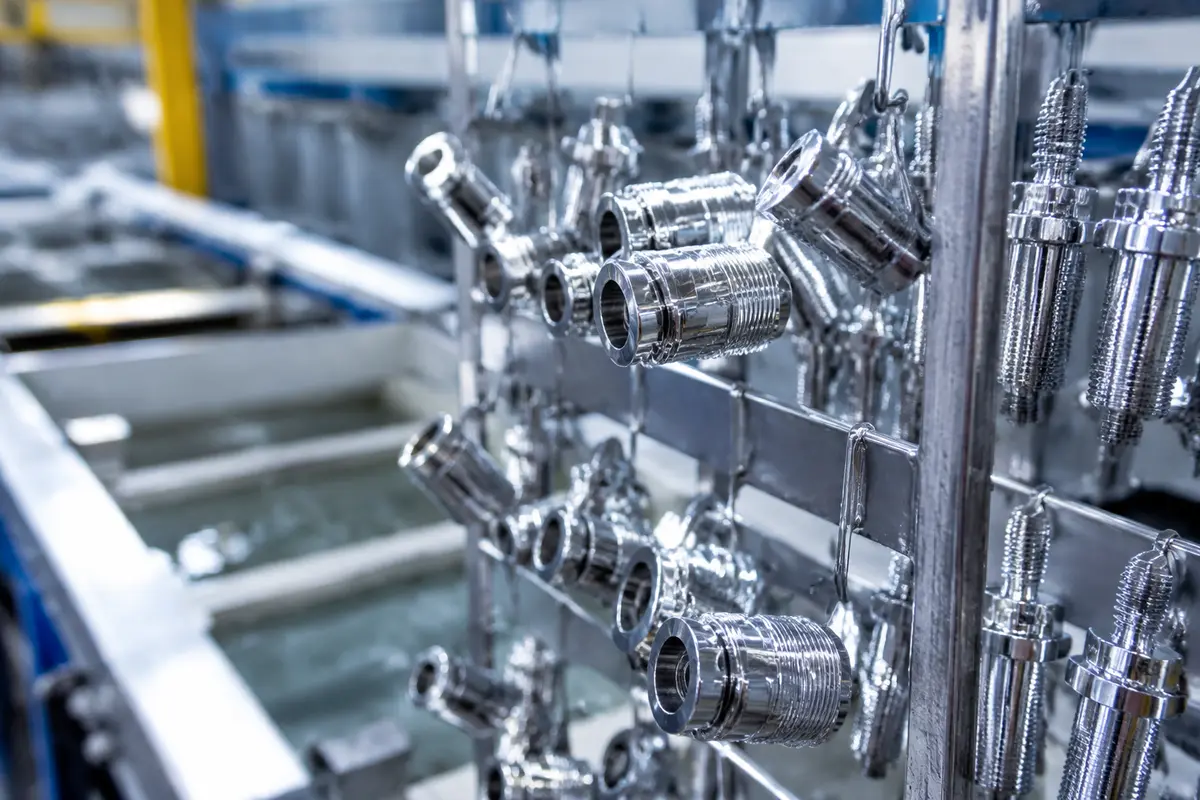
Nickel plating is the workhorse of the surface finishing industry — accounting for over 11% of global electroplating output. It delivers the perfect balance of corrosion protection, wear resistance, and aesthetic appeal at a fraction of the cost of precious metals. Whether it's the gleaming chrome-like finish on a bathroom faucet, the durable underplate beneath a gold-plated connector, or the uniform coating inside a complex pump housing — nickel is almost certainly involved. Yet specifying nickel plating is far from straightforward: the choice between electrolytic bright nickel, semi-bright nickel, and electroless nickel dramatically affects cost, corrosion resistance, appearance, and service life. This guide helps engineers and procurement managers navigate the nickel plating decision matrix.
🥇 The Nickel Plating Trilemma: Corrosion vs Appearance vs Cost
Every nickel plating decision involves trading off three factors. Bright nickel offers the best appearance but the lowest corrosion resistance. Semi-bright nickel delivers superior corrosion protection but lacks luster. Electroless nickel provides unmatched uniformity and hardness but costs 2–3× more. The right choice depends entirely on your application's priorities.
✨ Type 1: Bright Nickel Plating
Best for: decorative hardware, automotive trim, consumer goods, furniture fittings
Bright nickel is produced by adding organic brighteners (saccharin, coumarin, and proprietary additives) to a Watts nickel bath. These brighteners adsorb onto the cathode surface during deposition, refining grain structure to sub-micron levels and producing a near-mirror finish — eliminating the need for post-plate polishing.
- Composition: 99%+ nickel with trace sulfur (0.03–0.05%) from brightener incorporation
- Hardness: 400–550 HK₁₀₀ (moderate wear resistance)
- Corrosion resistance: Moderate — the incorporated sulfur reduces electrochemical nobility, making bright nickel anodic to semi-bright nickel in multi-layer systems
- Thickness range: 5–25 μm for decorative / 10–40 μm for functional
- Appearance: Highly reflective, mirror-like luster (Ra < 0.05 μm achievable)
- Cost factor: ~$0.10–0.30 per dm² at 10 μm
- Typical applications: Faucet handles, door hardware, automotive emblems, zipper bodies, handbag frames, furniture legs
- Key standard: ASTM B456 / ISO 1456 for decorative Ni-Cr coatings
🛡️ Type 2: Semi-Bright Nickel Plating
Best for: corrosion-critical undercoats, automotive functional components, outdoor hardware
Semi-bright nickel is deposited from a Watts bath containing sulfur-free organic additives (coumarin derivatives, butynediol). These produce a columnar grain structure with extremely low sulfur content (<0.005%). This is the critical innovation behind duplex nickel — the industry-standard corrosion protection system where a sulfur-free semi-bright layer is topped with a sulfur-containing bright layer, creating an electrochemical couple that sacrificially protects the substrate.
- Composition: ≥99.5% nickel, sulfur < 0.005%
- Hardness: 300–400 HK₁₀₀ (lower than bright nickel)
- Corrosion resistance: Excellent — low sulfur content ensures nobility; in duplex systems, the bright layer corrodes preferentially, preventing pit penetration to the substrate
- Thickness range: 10–30 μm in duplex systems (typically 60-75% of total nickel thickness)
- Appearance: Semi-lustrous to satin (Ra 0.1–0.3 μm) — not suitable as a visible finish
- Cost factor: ~$0.08–0.25 per dm² at 10 μm
- Typical applications: Automotive bumpers, motorcycle parts, marine hardware, outdoor lighting, plumbing fixtures for corrosive environments
- Key standard: ASTM B456 Type SC-3 / SC-4 (duplex nickel + microporous chromium)
⚗️ Type 3: Electroless Nickel Plating (EN)
Best for: internal surfaces, complex geometries, oil & gas components, precision machinery
Electroless nickel is fundamentally different — it's an autocatalytic chemical reduction process that requires no electric current. Sodium hypophosphite reduces nickel ions onto the catalytic surface, codepositing 3–13% phosphorus. Because there's no current distribution effect, EN coats every surface uniformly — inside blind holes, around sharp edges, and through internal passages — with thickness variation typically under ±5%.
- Composition: 87–97% Ni + 3–13% P (phosphorus content determines properties)
- Hardness: 450–550 HK as-plated; 850–1,000 HK after heat treatment at 400°C (approaching hard chromium)
- Corrosion resistance (ASTM B733): Low-P (1–3%): alkaline resistance | Mid-P (4–7%): general purpose | High-P (10–13%): superior acid resistance, amorphous, non-magnetic
- Thickness range: 5–75 μm (exceptional uniformity ±2 μm across complex parts)
- Appearance: Semi-bright silver-gray (varies with phosphorus content)
- Cost factor: ~$0.25–0.60 per dm² at 10 μm (2–3× electrolytic nickel)
- Typical applications: Valve bodies, pump impellers, hydraulic cylinders, oilfield downhole tools, aerospace fasteners, mold cavities, food processing equipment
- Key standard: ASTM B733 / MIL-DTL-26074 / AMS 2404 (aerospace EN)
📊 Nickel Plating Performance Matrix
Head-to-head comparison across five critical performance dimensions
| Property | Bright Ni | Semi-Bright Ni | Electroless Ni |
|---|---|---|---|
| Appearance | ⭐⭐⭐⭐⭐ Mirror | ⭐⭐ Satin | ⭐⭐⭐ Semi-bright |
| Corrosion (CASS 24h) | ⭐⭐ 6–8 rating | ⭐⭐⭐ 8–9 rating | ⭐⭐⭐⭐⭐ 9–10 rating (High-P) |
| Hardness (as-plated) | 400–550 HK | 300–400 HK | 450–550 HK (850+ heat-treated) |
| Thickness Uniformity | ±30% (poor on edges) | ±25% (poor on edges) | ±5% (excellent) |
| Cost (at 10 μm) | $0.10–0.30/dm² | $0.08–0.25/dm² | $0.25–0.60/dm² |
| Internal surface coverage | ❌ Poor (Faraday cage) | ❌ Poor (Faraday cage) | ✅ Excellent |
🔬 The Duplex Nickel System: How to Achieve Automotive-Grade Corrosion Protection
The duplex (or bi-layer) nickel system — a semi-bright layer topped with bright nickel — is the gold standard for outdoor hardware exposed to de-icing salts and coastal environments. Here's how it works:
- Semi-bright base layer: Sulfur-free (<0.005% S), electrochemically noble. Deposited to 60-75% of total thickness. Columnar grain structure resists pit penetration.
- Bright top layer: Contains 0.03-0.05% sulfur from brighteners, making it anodic to the semi-bright layer. When corrosion initiates, it spreads laterally across the bright layer rather than penetrating vertically into the semi-bright layer — protecting the substrate.
- Chromium flash (optional): 0.25–0.5 μm microporous or microcracked chromium top layer distributes corrosion current across thousands of microscopic sites, preventing concentrated pitting.
Performance benchmark: Duplex nickel (25 μm total) + microporous chromium passes CASS 24-hour with rating ≥9. Single-layer bright nickel (25 μm) typically achieves CASS rating 6-7. This is not a marginal improvement — it's a fundamental upgrade in corrosion mechanism.
🔀 Quick Selection Guide: Which Nickel Type Should You Specify?
🏠 Indoor Decorative
→ Bright Nickel
Faucets, handles, furniture hardware. Mirror finish, low cost.
🌧️ Outdoor / Automotive
→ Duplex Nickel
Bumpers, marine hardware, lighting. CASS rating ≥9 required.
⚙️ Complex Internal Surfaces
→ Electroless Nickel
Valves, pumps, molds. Uniform coating without current distribution.
🔧 Wear + Hardness
→ EN Mid-P + Heat Treat
850+ HK after 400°C. Rivals hard chrome without hexavalent Cr.
💰 Cost-Sensitive Decorative
→ Bright Ni + Cr Flash
Standard chrome-look at lowest cost. Acceptable for indoor use.
🔍 Quality Verification: 5 Tests Your Nickel-Plated Parts Should Pass
- Thickness measurement (XRF): Per ASTM B568. Non-destructive, ±10% accuracy at 5 μm. Cross-sectional microscopy for dispute resolution.
- Adhesion test: Bend test (ASTM B571 §5) — 180° bend on mandrel, no flaking. Thermal quench — heat to 250°C, quench in water, no blistering.
- CASS accelerated corrosion: ASTM B368 — Copper-Accelerated Acetic Acid Salt Spray. 24 hours CASS for decorative, 48+ hours for automotive.
- Porosity (electrographic): ASTM B798 — essential for duplex systems. Detects microscopic pores that would become corrosion sites.
- Phosphorus content (EN only): EDS or wet chemistry — verify P% matches specification (Low-P / Mid-P / High-P). Directly determines corrosion and hardness properties.
Need Reliable Nickel Plating for Your Hardware Products?
From mirror-bright decorative finishes to MIL-spec electroless nickel for precision components — PlatingClub delivers consistent quality backed by XRF thickness certification and full CASS corrosion testing. Explore our nickel plating capabilities and discuss your requirements with our technical team.
Last updated: June 2026. This guide provides general reference information. Always consult your plating supplier for application-specific recommendations and validate performance under your actual service conditions.