
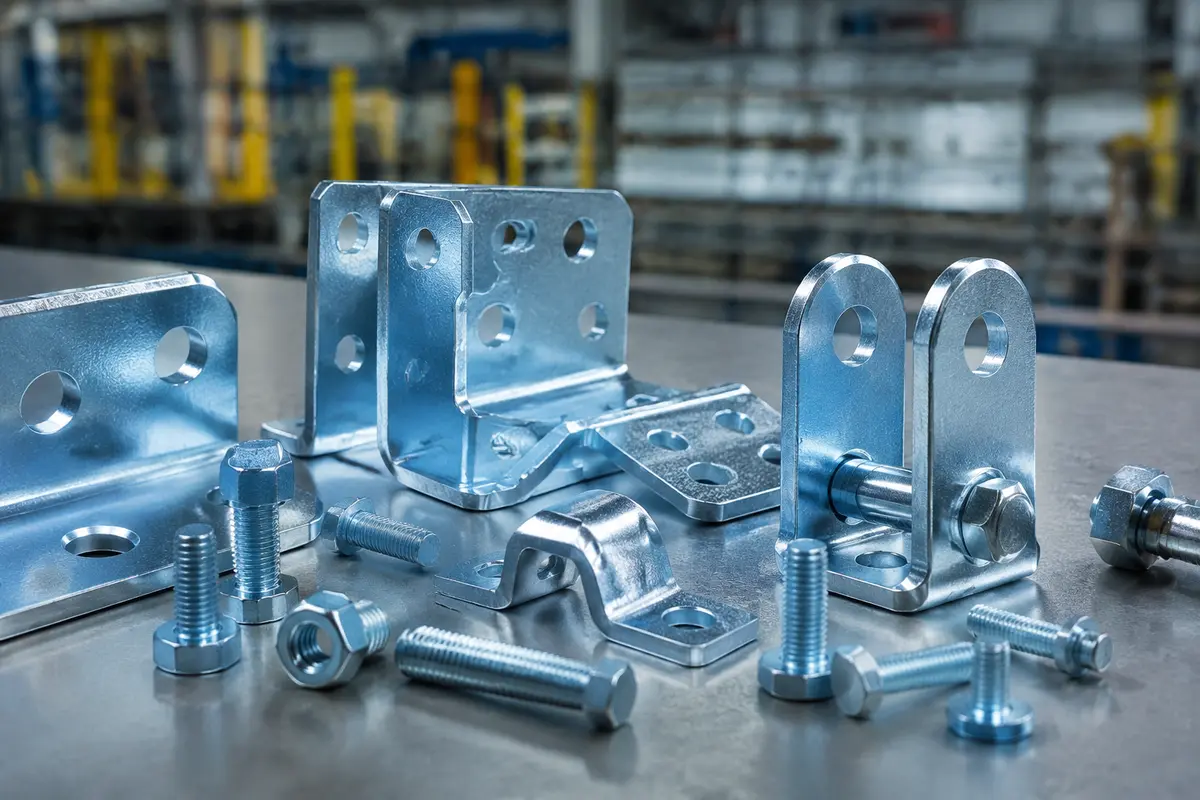
Zinc plating is the most widely used electroplating process in the world — accounting for over 50% of all electroplated parts produced annually. For industrial hardware buyers and manufacturing engineers, understanding zinc plating types, chromate conversion coatings, and corrosion resistance standards is essential to specifying the right finish. This guide breaks down everything you need to know to make informed sourcing decisions.
⚙️ Three Main Types of Zinc Plating
Each plating bath type offers distinct advantages for different applications. Your choice affects cost, production speed, and final part quality.
🔹 Acid Zinc (Chloride-Based)
Best for: bright, decorative finishes on steel
Acid zinc — typically potassium chloride or ammonium chloride baths — delivers high brightness and excellent throwing power. It plates rapidly at high current densities, making it ideal for high-volume production lines. The deposit is ductile and works well with post-plate forming operations.
- Plating speed: Fast (25-40 μm/hour at 2-4 A/dm²)
- Brightness: Excellent — achieves mirror-like finish without mechanical polishing
- Throwing power: Good (60-80% at low current density areas)
- Typical use: Fasteners, stampings, wire goods, automotive brackets
- Limitation: Lower corrosion resistance than alkaline in unpassivated state
🔸 Alkaline Zinc (Non-Cyanide)
Best for: tubular parts, deep recesses, superior corrosion resistance
Alkaline non-cyanide zinc offers exceptional throwing power — it plates evenly into recessed areas, inside tubes, and around complex geometries that acid zinc cannot reach. The deposit is slightly less bright but delivers better corrosion resistance, especially after chromate passivation.
- Plating speed: Moderate (15-25 μm/hour at 1-3 A/dm²)
- Throwing power: Excellent (80-95% at low current density areas)
- Corrosion resistance: 20-30% better than acid zinc in salt spray testing
- Typical use: Tubular structures, castings, hydraulic fittings, coil springs
- Consideration: Slower plating rate; requires more careful bath maintenance
| Property | Acid Zinc (Cl⁻) | Alkaline Zinc |
|---|---|---|
| Brightness | ⭐⭐⭐⭐⭐ | ⭐⭐⭐ |
| Throwing Power | ⭐⭐⭐ | ⭐⭐⭐⭐⭐ |
| Plate Speed | ⭐⭐⭐⭐⭐ | ⭐⭐⭐ |
| Corrosion (bare) | ⭐⭐⭐ | ⭐⭐⭐⭐ |
| Cost per μm | $ | $$ |
🎨 Chromate Conversion Coatings: The Secret to Zinc's Durability
Bare zinc provides moderate protection. Chromate passivation multiplies corrosion resistance by 5-10× while adding color options and improving paint adhesion.
Types of Chromate Conversion
🔵 Clear / Blue Chromate
Salt spray: 12-24 hours to white rust
Thinnest film (~0.05 μm). Maintains bright metallic appearance. Good for indoor hardware, electronic connectors, and parts where aesthetics matter.
🟡 Yellow / Gold Chromate
Salt spray: 72-96 hours to white rust
Medium film (~0.25 μm). Industry standard for automotive under-hood components, construction fasteners, and general outdoor use. Hexavalent (Cr⁶⁺) provides highest corrosion resistance.
⚫ Black Chromate
Salt spray: 48-72 hours to white rust
Thick film (~0.5 μm) with silver-doped chemistry. Popular for military applications, optical equipment, and premium automotive exterior parts. Often top-coated for 200+ hour performance.
🟢 Olive Drab Chromate
Salt spray: 96-150 hours to white rust
Heaviest chromate film (~0.5-1.0 μm). Military specification finishes (MIL-DTL-16232). Exclusive to hexavalent chromium chemistry. Maximum corrosion protection.
⚠️ Environmental Compliance: Hexavalent vs Trivalent Chromate
REACH, RoHS, and ELV regulations have driven the shift from hexavalent (Cr⁶⁺) to trivalent (Cr³⁺) chromate. While Cr³⁺ is safer for workers and the environment, it historically delivered lower corrosion resistance. Modern trivalent processes with sealers now match or exceed Cr⁶⁺ performance — reaching 120-200+ hours in salt spray testing.
Key compliance deadlines: EU ELV Directive 2000/53/EC banned Cr⁶⁺ on vehicles from July 2007. REACH Annex XIV listed chromium trioxide as requiring authorization since 2017. US OSHA lowered Cr⁶⁺ workplace exposure limits to 5 μg/m³ (8-hour TWA).
📏 Zinc Plating Thickness Guide by Application
Per ASTM B633 and ISO 2081, zinc coating thickness directly determines service life. Below is the industry-standard classification.
| Service Condition | ASTM B633 Type | Min. Thickness | Salt Spray (to white rust) | Typical Application |
|---|---|---|---|---|
| SC 1 — Mild (Indoor) | Fe/Zn 5 | 5 μm | 12 h | Indoor electronics, furniture hardware |
| SC 2 — Moderate | Fe/Zn 8 | 8 μm | 24 h | Indoor plumbing, light industrial |
| SC 3 — Severe | Fe/Zn 12 | 12 μm | 72 h | Outdoor construction, automotive chassis |
| SC 4 — Very Severe | Fe/Zn 25 | 25 μm | 96+ h | Marine, offshore, heavy equipment |
🔬 Hydrogen Embrittlement: A Critical Risk for High-Strength Steel
High-strength steels (>1000 MPa / HRC 35+) are susceptible to hydrogen embrittlement during zinc electroplating. Atomic hydrogen produced at the cathode diffuses into the steel, causing brittle failure under load — sometimes days after plating.
Mitigation: Post-plating hydrogen embrittlement relief bake at 190-210°C within 4 hours of plating. Duration: 3-24 hours depending on steel strength grade. Per ASTM B850 and ISO 9588. Always specify baking requirements on your purchase order for Grade 10.9/12.9 fasteners.
✅ What to Specify on Your Zinc Plating Purchase Order
A clear specification prevents costly miscommunication. Here's a practical checklist for industrial buyers:
- Base material: Steel grade, hardness (HRC), any prior heat treatment
- Zinc bath type: Acid chloride OR alkaline non-cyanide (specify which)
- Thickness: ASTM B633 Type (e.g., Fe/Zn 12) or minimum μm required
- Chromate type: Clear/blue, yellow, black, or olive drab — AND specify Cr³⁺ or Cr⁶⁺
- Sealer/topcoat: Required for 96+ hour salt spray targets
- Hydrogen embrittlement relief: Required for fasteners Grade 10.9+ and HRC 35+ steel
- Testing requirements: Salt spray (ASTM B117), thickness measurement (ASTM B487 / XRF), adhesion (ASTM B571)
- Packaging: VCI paper, desiccants, or oil coating for ocean freight
Need Zinc Plating for Your Hardware Components?
From standard zinc barrel plating for fasteners to precision rack plating for complex geometries — we deliver consistent quality with full chromate passivation options and salt spray certification.
Last updated: June 2026. This guide is for reference purposes. Always consult your plating supplier for application-specific recommendations and test your parts under actual service conditions.