
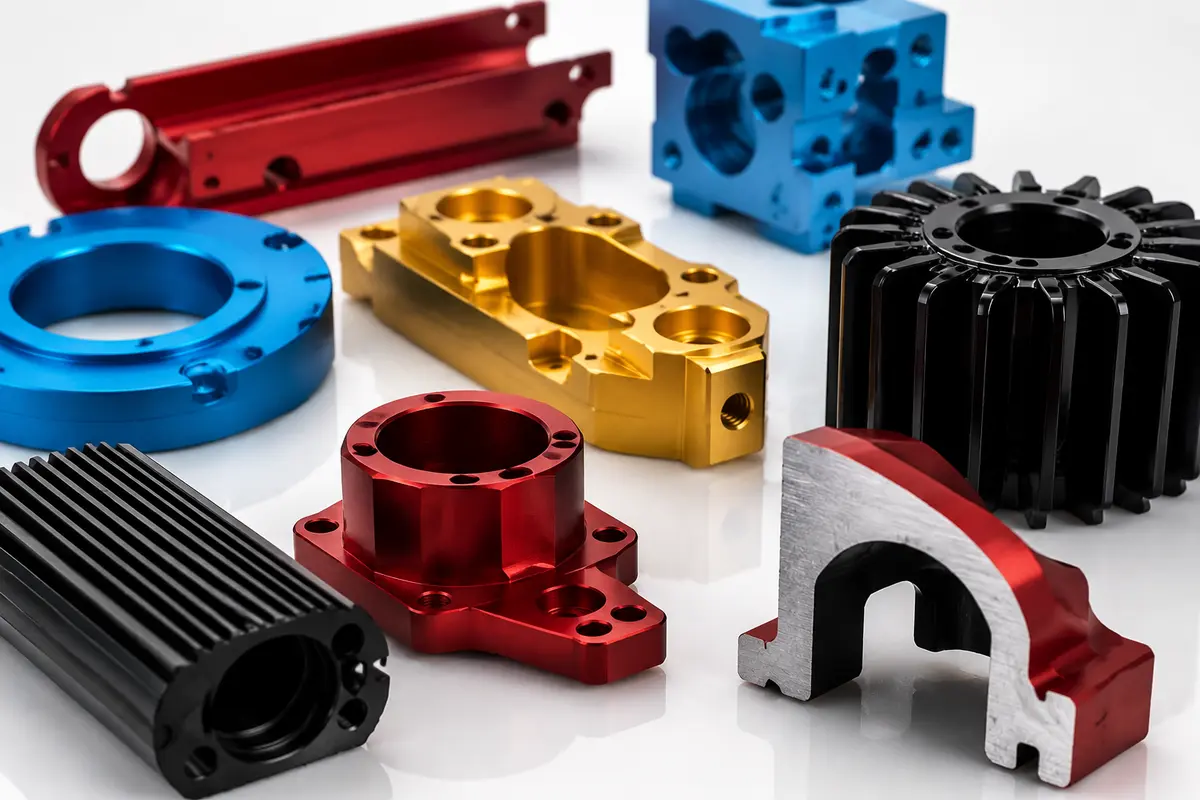
Anodizing is electroplating's quieter sibling — less flashy, but powering everything from iPhone casings to aircraft landing gear. While electroplating adds a metallic layer on top of a substrate, anodizing transforms the aluminum surface itself into a hard, corrosion-resistant ceramic oxide. For procurement managers and engineers sourcing aluminum components, understanding the anodizing decision matrix — Type II vs. Type III, sulfuric vs. chromic, clear vs. dyed — directly impacts part performance, cost, and lead time. This guide clarifies the choices.
🔬 Anodizing Is Not a Coating — It's a Conversion
Unlike electroplating which deposits foreign metal atoms onto a surface, anodizing grows a controlled aluminum oxide (Al₂O₃) layer from the base metal itself. The oxide is integral to the part — it cannot chip or peel like a coating. This fundamental difference explains why anodized parts excel in wear applications where plated coatings fail.
🏭 Type II: Sulfuric Acid Anodizing (Decorative & General Purpose)
Best for: consumer electronics, architectural components, automotive trim, general industrial parts
Type II is the most common anodizing process, using a 15–20% sulfuric acid electrolyte at 18–22°C. The resulting oxide layer is 5–25 μm thick with a porous hexagonal column structure that readily accepts dyes — enabling the vibrant colors seen on consumer products.
- Thickness: 5–25 μm (MIL-A-8625 Type II)
- Hardness: 200–350 HV (moderate wear resistance)
- Corrosion resistance (NSS): 336+ hours per ISO 9227 when sealed
- Dyeability: Excellent — the porous structure absorbs organic and inorganic dyes before sealing
- Cost factor: ~$0.15–0.40 per dm² at 15 μm (most economical surface treatment for aluminum)
- Typical applications: Laptop bodies, smartphone frames, architectural panels, bicycle components, cookware, automotive trim
- Key specification: MIL-A-8625 Type II / ISO 7599
- Limitation: Not suitable for high-wear or high-temperature applications (>80°C causes seal degradation)
⚙️ Type III: Hardcoat Anodizing (Engineering & Wear-Resistant)
Best for: aerospace components, hydraulic cylinders, gears, firearm parts, medical devices
Type III uses the same sulfuric acid chemistry but at 0–5°C with higher current density and voltage (up to 100V). The low temperature suppresses oxide dissolution, producing a dense, thick layer (25–150 μm) with hardness approaching 500–700 HV — rivaling case-hardened steel.
- Thickness: 25–150 μm (typically 50 μm for most applications)
- Hardness: 500–700 HV (comparable to hardened tool steel at 60 HRC)
- Corrosion resistance: Excellent — 1,000+ hours NSS when properly sealed with PTFE or nickel acetate
- Dyeability: Limited — the dense structure accepts only dark colors (black, dark green, dark brown); lighter dyes appear muted
- Cost factor: ~$0.40–1.00 per dm² at 50 μm (2–3× Type II due to refrigeration and longer process time)
- Typical applications: Aircraft landing gear, hydraulic pistons, valve bodies, firearm receivers, gears, pulleys, food processing equipment, semiconductor chamber components
- Key specification: MIL-A-8625 Type III / AMS 2482
- Note: Type III grows approximately 50% inward and 50% outward from the original surface — account for ~25 μm dimensional growth per side at 50 μm thickness
📊 Type II vs Type III: Head-to-Head Performance Matrix
Critical decision factors for specifying engineers and procurement teams
| Property | Type II (Sulfuric) | Type III (Hardcoat) |
|---|---|---|
| Thickness Range | 5–25 μm | 25–150 μm |
| Hardness | 200–350 HV | 500–700 HV |
| Wear Resistance (Taber) | Moderate (200–400 cycles) | Excellent (5,000+ cycles) |
| Color Options | Full spectrum (vibrant) | Dark colors only (muted) |
| Dielectric Strength | ~500 V at 25 μm | ~800 V at 50 μm |
| Cost (per dm²) | $0.15–0.40 | $0.40–1.00 |
| Process Temperature | 18–22°C | 0–5°C |
🔧 Beyond Type II & III: Specialty Anodizing Processes
Type I — Chromic Acid Anodizing: The original aerospace process (MIL-A-8625 Type I). Uses chromic acid at 35–40°C, producing a thin (2–5 μm), non-porous, corrosion-resistant layer. Ideal for fatigue-critical aerospace structures because it doesn't reduce fatigue strength. Note: Declining use due to hexavalent chromium (Cr⁶⁺) environmental restrictions under REACH and OSHA.
Phosphoric Acid Anodizing (PAA): Produces a thin, highly porous oxide optimized for adhesive bonding — the standard for aerospace structural bonding (Boeing BAC 5555). The pore morphology provides mechanical interlocking for epoxy adhesives.
Boric-Sulfuric Acid Anodizing (BSAA): Developed as a Cr⁶⁺-free replacement for Type I. Used extensively on Boeing 787 and Airbus A350 structural components. Provides equivalent corrosion protection and bond durability without the environmental liability of chromic acid.
🔍 5 Quality Tests Every Anodized Part Should Pass
- Thickness Measurement (Eddy Current): Per ASTM B244. Non-destructive, ±1 μm accuracy. Measure on flat surfaces — edge readings are unreliable due to current density effects.
- Seal Quality (Dye Stain Test): Per ASTM B136. Apply dye to sealed surface for 5 minutes, then wipe. Any dye retention indicates incomplete sealing — a precursor to corrosion failure.
- Coating Weight (Gravimetric): Per ASTM B137. Weigh before and after chemical stripping in phosphoric-chromic acid solution. Determines average coating mass per unit area.
- Abrasion Resistance (Taber Abraser): Per ASTM D4060. CS-17 wheels, 1000g load. Type III should withstand 5,000+ cycles before substrate exposure.
- Salt Spray Corrosion (NSS): Per ASTM B117 / ISO 9227. Type II sealed: 336+ hours without pitting. Type III sealed: 1,000+ hours.
🔀 Quick Selection: Which Anodizing Should You Specify?
📱 Consumer Electronics
→ Type II + Dye + Seal
iPhone frames, laptops, wearables. Vibrant colors, good durability.
🛩️ Aerospace Structural
→ BSAA or Type I
Fatigue-critical parts, adhesive bonding. Thin, non-embrittling.
⚙️ Hydraulic/Wear Parts
→ Type III Hardcoat
Cylinder bores, pistons, gears. 50 μm minimum, PTFE seal optional.
🏗️ Architectural
→ Type II, 15–20 μm
Curtain walls, window frames. UV-stable inorganic pigments, hot-water sealed.
Need Precise Surface Finishing for Your Aluminum Components?
Whether you need Type II decorative anodizing with vibrant colors or MIL-spec Type III hardcoat for demanding engineering applications — PlatingClub delivers certified quality with eddy-current thickness verification and full salt-spray corrosion testing. Explore our surface treatment capabilities and discuss your technical requirements with our team.
Last updated: June 2026. Aluminum alloy selection significantly affects anodizing results — 6061 anodizes well; high-silicon casting alloys (A380, A356) produce dark, non-uniform coatings. Always consult your surface finishing supplier for alloy-specific recommendations and validate performance under your actual service conditions.