
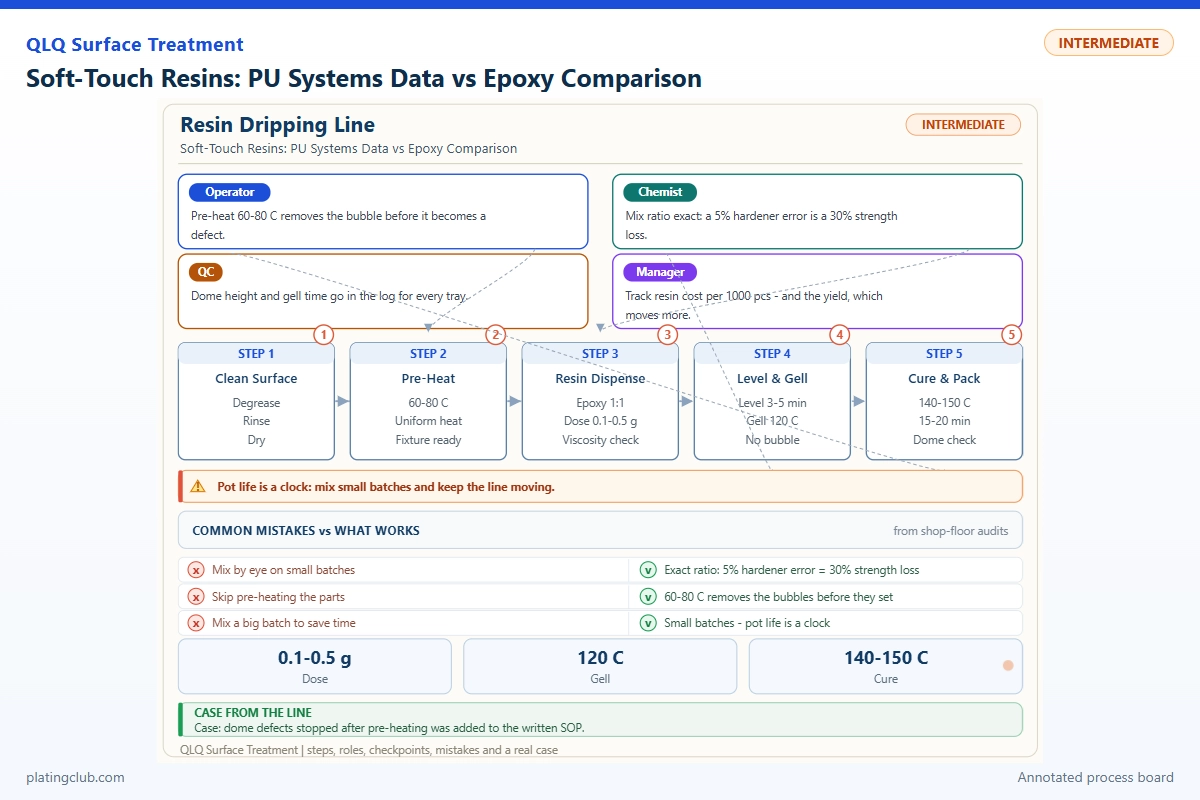
Resin Dripping / Junior Technician / Working Data
Soft-Touch Resins: PU Systems Data vs Epoxy Comparison
A clear dome on a plated puller, badge or bag fitting can look perfect and still fail when handled. The junior technician's job is to distinguish softness from incomplete cure, then control weighing, moisture, dispensing and curing consistently. “PU” and “epoxy” describe chemistry, not a guaranteed feel. Either family can contain flexible or rigid grades.
Start with the approved product code, current technical data sheet, safety data sheet and customer-approved sample. A glossy, flexible dome is not necessarily the same finish as a thin, matte soft-touch coating. Do not substitute a spraying resin for a dripping resin because both are described as soft-touch.
Evidence boundary: Published supplier values below are reference data, not QLQ production results. No matched PU-versus-epoxy salt-spray report was available in the reviewed QLQ knowledge base. The paired trial plan therefore leaves unmeasured results explicitly pending. Proposed shop limits require engineer approval before production release.
1. Select the Feel, Then the Chemistry
For a recessed decorative insert, ask whether the dome should recover after finger pressure, resist scratching, survive flexing or retain clarity outdoors. Those are separate requirements. Hardness alone does not describe friction, tack, abrasion resistance or adhesion to the underlying lacquer.
One useful reference is TPUCO's doming range: its published table spans Shore A 69 to Shore D 80, with different ratios and cure schedules. That range demonstrates why a product-specific specification matters more than a generic PU label. Source: TPUCO doming product data.
| Selection question | Flexible PU route | Epoxy route | Junior technician action |
|---|---|---|---|
| Is a compliant dome needed? | Select a specified Shore A grade. | Flexible grades exist; rigid grades are unsuitable substitutes. | Compare fully cured samples, not fresh pours. |
| Will the fitting see sunlight? | Evaluate a documented outdoor grade. | Require grade-specific weathering evidence. | Request the exposure protocol and appearance limit. |
| Can the line control humidity? | Moisture control can be critical. | Follow the selected grade's moisture restrictions. | Log conditions at the dispensing bench. |
| Is the plated surface lacquered? | Adhesion must be checked on that lacquer. | The same requirement applies. | Keep substrate and lacquer batches traceable. |
Do not numerically equate Shore A with Shore D. A small dome over metal also gives a substrate-influenced reading. Use a separate test plaque with the geometry required by the approved hardness method, and record scale, specimen thickness, cure age and temperature.
2. Published Test Data and a Paired Coupon Experiment
The first rows are manufacturer-reported physical data; they are not a controlled head-to-head experiment. The final rows define a practical comparison that your laboratory must complete. Never fill a missing salt-spray value with a sales estimate.
| Specimen / batch reference | Thickness | Hardness / working data | Salt-spray result | Test condition |
|---|---|---|---|---|
| Neumann PU 2016 M12 / IC 300; published reference | Not reported | Shore A 72–78; pot life 11–13 min | Not reported | Hardness: 23°C, after 10 days. Pot life: 100 g at 23°C. |
| TPUCO CPU-105-269B-A/B; published reference | Not reported | Shore A 69; working time 15 min | Not reported | Listed cure: 50°C for 7 h; hardness specimen geometry and working-time sample mass not disclosed. |
| Fong Yong rigid epoxy doming family; published reference | Not reported | Family range: Shore D 70–80 | Not reported | Family-level value; exact grade, conditioning and specimen geometry require confirmation. |
| PU-P1: three same-lot plated coupons | Target 1.00 ± 0.10 mm; measured value pending | Measure approved Shore A plaque; result pending | Pending laboratory measurement | Selected PU's approved cure; condition and inspect at a fixed age. Proposed screening: 96 h neutral salt spray, subject to customer approval. |
| EP-E1: three matched plated coupons | Same target and measurement locations | Measure grade-appropriate plaque; result pending | Pending laboratory measurement | Selected epoxy's approved cure; same inspection age and salt-spray protocol as PU-P1. |
Reference values: Neumann technical datasheet, TPUCO product table and Fong Yong epoxy family data.
Use identical zinc-alloy substrate lots, plating stacks, cleaning and lacquer conditions. Add an undomed plated control. Record scribed or unscribed condition, edge masking, dome thickness and all replicates; report blistering, corrosion location and edge lift separately. A resin can hide corrosion without preventing it. The proposed 96-hour screen is not an established pass claim or a prediction of outdoor lifetime.
Photograph each coupon before and after exposure using consistent lighting. Ask the laboratory to specify its current test method and acceptance criteria. If the customer requires a different duration, rating system or coating stack, use that specification rather than this screening plan.
3. Complete Working Formula: Matched Two-Part PU Kit
This is a complete dispensing formula using preformulated commercial components, not an invented raw-material manufacturing recipe. Neumann's reference kit specifies resin:hardener at 100:110 by mass, but 1:1 by volume. Its component densities differ; therefore a volumetric ratio must not be copied into a weighing instruction. Source: Neumann PU kit datasheet.
| Component | Range | Typical | Function | Replenishment |
|---|---|---|---|---|
| Matched formulated resin | 100 mass parts fixed; no discretionary range | 47.62 g per 100 g mixture | Resin-side formulation for the cured network | Refill its separate reservoir with approved same-grade material; record lot. |
| Matched formulated hardener | 110 mass parts fixed; no discretionary range | 52.38 g per 100 g mixture | Reactive partner controlling network formation | Refill separately; verify delivered ratio after refill. |
| Added solvent, water, pigment or catalyst | 0 unless supplier approves a revised formula | 0 g | Excluded from this clear-kit formula | None; never thin or “repair” an ageing mixture. |
The total is 100.00 g. Calculate hardener mass as resin mass × 1.10. A 20.00 g resin charge therefore requires 22.00 g hardener. Batch size still needs approval: reaction heat and residence time change with container geometry. Do not assume the same pot life for a deep kilogram pot.
“Replenishment” here means feeding separate unmixed supplies. There is no plating-bath-style correction of mixed resin. Discard material beyond its validated dispensing age through the approved waste route; adding fresh hardener cannot restore its original processing window.
4. Trend Bands and Stop Thresholds
The following are proposed qualification limits for a monitored cell, not universal resin specifications. Only the humidity boundary explicitly identified below comes from the named supplier. Changeover to another grade requires a new control sheet. Non-aqueous doming resin has no useful plating-bath pH adjustment routine.
| Parameter | Normal working band | Danger / hold threshold | Required response |
|---|---|---|---|
| Bench relative humidity | Proposed 35–45% RH | For EU-118S-5S/HU-118S-5S: ≥50% RH violates the published boundary | Stop dispensing; restore dehumidification and inspect exposed material. |
| Material temperature | Proposed 23–25°C | Outside qualified 20–28°C envelope | Hold and condition sealed supplies; investigate viscosity change. |
| Delivered B:A mass ratio, Neumann kit | Proposed 1.089–1.111; target 1.100 | Outside that provisional ±1% band | Hold output since last good check; confirm supplier tolerance. |
| Mixed-material age, Neumann 100 g reference | Proposed dispense within 0–8 min at 23°C | Over 8 min internal cutoff; published pot life starts at 11 min | Replace charge; do not wait for visible gel. |
| Dome thickness | Proposed 0.90–1.10 mm for a 1.00 mm drawing | Outside drawing tolerance or any overflow | Hold parts; check shot mass, fixture level and cavity dimensions. |
| Shot mass | Proposed ±3% around qualified nominal | Outside ±3%, or progressive drift across three checks | Check nozzle restriction, pressure and scale before adjustment. |
The humidity requirement is grade-specific: Fong Yong EU-118S-5S/HU-118S-5S technical information. Do not combine that grade's cure schedule with the Neumann formula. These examples illustrate separate control decisions, not a hybrid recipe.
Trend readings against time, refills and nozzle changes. A gradual increase in shot mass variation is an early warning even while individual shots remain acceptable. Record the intervention and restart sample so the next shift can distinguish a process change from measurement noise.
5. Engineer Notes: Seven Actions Before Blaming the Resin
- Verify identity. Match both container codes to the work instruction. Quarantine a mismatched hardener rather than trialling it on production hardware.
- Check weighing. Zero a clean cup, verify the balance with a check weight and capture actual component masses. For automated equipment, use the manufacturer's approved separate-stream ratio check.
- Keep the surface dry. Handle cleaned fittings with clean gloves. Isolate oily, fingerprinted or visibly wet parts; use only the approved cleaning and drying procedure.
- Control air introduction. Mix without whipping, scrape the vessel walls and use validated vacuum degassing where permitted. Never use a flame over resin to remove bubbles.
- Validate the first shots. After installing a static mixer, discard the approved startup quantity and examine a retained cured sample for streaks and tack.
- Measure cure, not oven display. Log representative part temperature and dwell. Do not extend heat arbitrarily: underlying lacquer, printing and fixtures may have lower temperature limits.
- Protect the operator. Review both SDSs; use specified chemical-resistant gloves, eye protection and assessed ventilation. Uncured resin and hardener are not made harmless by a clear appearance.
Escalate persistent tack, unexplained heat generation or a failed ratio check. Keep the affected lot on hold until the engineer defines disposition. Scraping off a defective dome and redripping is a rework process requiring validation, not an automatic recovery method.
6. Shift Checks That Leave a Useful Record
| Shift stage | Check item | Frequency | Acceptance criterion | Record |
|---|---|---|---|---|
| Before shift | Component identity, expiry and balance | Every startup | Matched approved kit; in date; balance check passes | Lot numbers, opening dates, check-weight result |
| Before shift | Bench conditions and substrate cleanliness | Startup and after prolonged stoppage | Approved temperature/RH bands; dry, uncontaminated surface | Temperature, RH, substrate and lacquer lot |
| During shift | Delivered ratio and shot mass | Hourly; after refill or mixer change | Qualified ratio and mass limits | Measured A/B masses, shot mass, equipment setting |
| During shift | Dome appearance and mixed age | Every charge; first and last sample | No streaks, overflow or unacceptable bubbles; within age cutoff | Mix-start time, sample ID, defect count |
| During shift | Cure profile | Each load | Approved part-temperature/time profile achieved | Logger reference and oven load ID |
| After shift | Retained samples and lot disposition | Each lot | Samples labelled; pending cure tests remain on hold | Sample location, release/hold status, signatures |
| After shift | Closure, cleaning and waste | Every shutdown | Supplies sealed; equipment cleaned by approved method | Shutdown checklist and segregated waste log |
7. Two Reference Applications to Turn Into Local Trials
Case A: an outdoor decorative panel. Fong Yong identifies outdoor panels as an application for its EU-118S-5S/HU-118S-5S PU. Published reference conditions include equal component masses and an 80°C, 120-minute cure. Treat this as an application reference, not proof for your plated bag fitting. Check substrate compatibility, actual part heating and the customer's weathering requirement before adoption. Manufacturer application reference.
Case B: a rigid decorative buckle insert. Fong Yong lists belt buckles and imitation hard enamel among applications for rigid epoxy grades. That is a different tactile objective from a soft dome. Trial the exact selected grade on the actual plated recess; record edge adhesion and handling damage before approving appearance. The supplier application listing contains no matched corrosion result or factory yield claim. Manufacturer epoxy application reference.
These are documented application categories, not invented customer success stories. For both, a successful local trial must include process records and failed samples as well as attractive photographs.
8. Technician-to-AI FAQ
“AI, my PU dome is soft after curing. How do I tell normal softness from under-cure?”
Compare at the specified cure age against an approved sample and a properly prepared hardness plaque. Check ratio records and the actual cure profile first. Smearing, transfer or unexpected tack needs investigation; a low hardness reading from a thin dome on metal is not sufficient evidence. Keep the lot on hold until the approved release tests pass.
“AI, can I add extra hardener or thinner to make this batch easier to drip?”
No, not without a supplier-approved revised formulation. Extra hardener changes stoichiometry; solvent changes flow, cure and potentially adhesion. Check material temperature, batch age, nozzle condition and delivered ratio instead. If mixed material is ageing, replace it through the approved waste procedure rather than refreshing the cup.
“AI, epoxy passed salt spray on another fitting. Can I approve it for this plated puller?”
Not from that result alone. Compare alloy, plating stack, lacquer, dome geometry, edge exposure, cure and test protocol. Request a matched trial on your puller and its plated control. A resin result cannot be separated from the substrate system, and salt spray does not establish tactile feel or sunlight durability.
9. What Would You Like to Solve?
Send the resin and hardener codes, substrate finish, desired feel, current cure profile, humidity log and photographs of the defect to [email protected]. Include the customer test specification and mark unmeasured results as pending. For coordinated equipment, chemistry and process planning, see turnkey surface-treatment lines and technical support.
Local knowledge reference: QLQ Obsidian Vault, sales/customer section, “Workshop Equipment and New Factory Investment FAQ,” Q44. It confirms soft-touch coating supply and supporting documents; it does not establish the third-party resin formulas or test outcomes above. Confirm the current supplier documentation before use.