
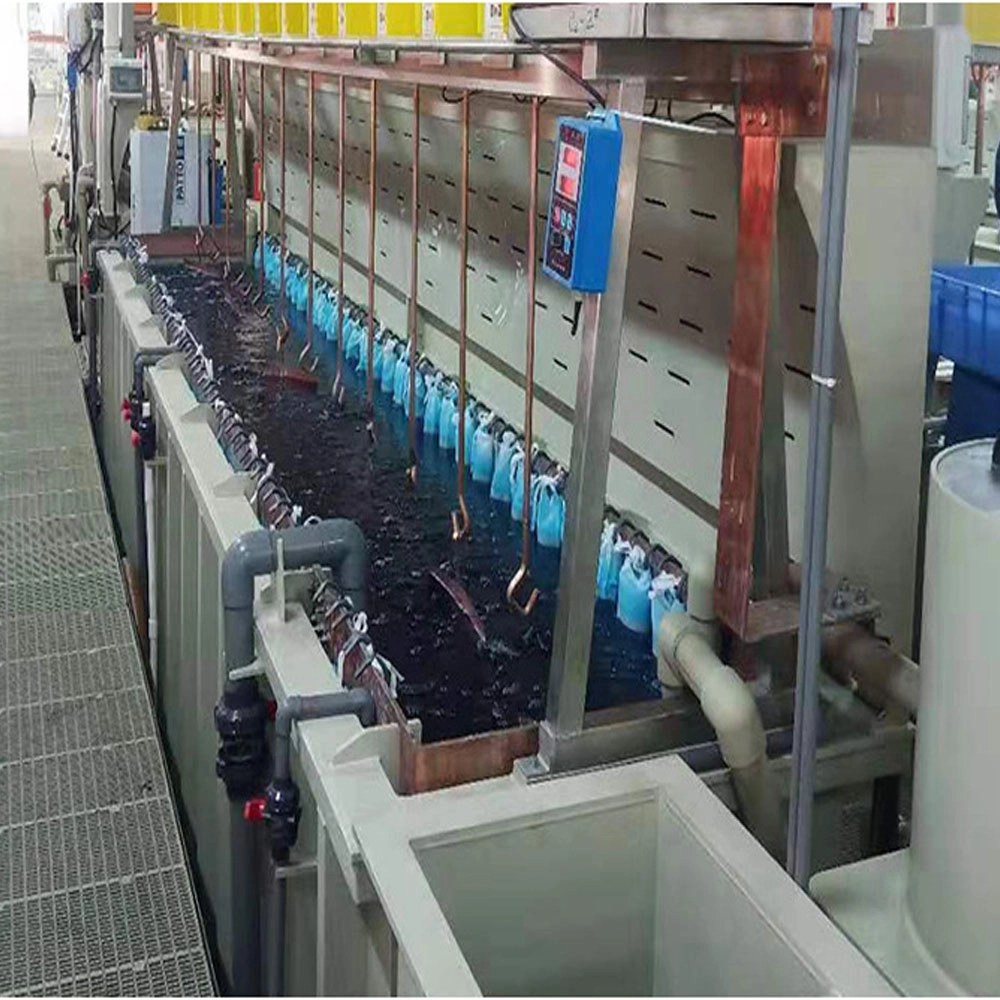
Barrel and rack plating are not two ways to do the same job; they are two different products. Barrel plating tumbles thousands of small parts in a rotating drum for low cost per piece, while rack plating holds each part individually for uniform, premium finishes. Choosing wrong - or mixing them without discipline - is one of the most expensive mistakes a finishing shop can make.
This guide compares both routes for zinc-alloy hardware, gives a decision framework, and shows how equipment and chemistry are selected in practice.
Common Mistakes and How to Avoid Them
The pitfalls that show up most often in real projects, with the cause and the practical fix.
| Mistake | Why It Happens | Practical Fix |
|---|---|---|
| 1. Using one bath for both without set-up control | Contact marks, burns and coverage drift | Dedicate barrels and racks to separate tanks, or log strict set-up changes |
| 2. Overloading the barrel | Deformed parts, skip plating, pitting | Keep load at 40-60% of volume and reduce speed for delicate parts |
| 3. Starting current while the drum is stationary | Burns on outer parts | Ramp current over 10-15 s after immersion |
| 4. Thin rack springs for heavy parts | High contact resistance, uneven deposit | Use copper-beryllium springs sized to part weight |
| 5. Ignoring recessed geometry | Bare spots in pockets and grooves | Use a deep-position agent and extend time rather than raising current |
| 6. Skipping pre-wet on racks | Air pockets leave bare areas | Pre-wet parts for 1 min and tilt racks 15-20 degrees |
| 7. No drag-out station at barrel transfer | Chemistry loss and cross-contamination | Add drip dwell over a recovery tank |
| 8. Judging quality by one part | Batch variation goes unnoticed | Check 5 parts per load at edge, centre and recess positions |
| 9. Wrong anode-to-cathode ratio | Poor distribution and anode passivation | Keep 1.5-2:1 and maintain anode bags |
| 10. Cutting drying time | Stains appear after packing | Dry to 70-90 C metal temperature with airflow |
Best Practices That Hold Up in Production
The operating disciplines that separate a reliable line from a reactive one.
- Classify parts by size, geometry and finish class before choosing the plating route
- Keep barrel rotation at 4-8 rpm; slower for springs and fine detail
- Inspect contacts and racks weekly; strip racks on schedule
- Log every barrel: load, current, time, temperature, brightener dose
- Run Hull cells on copper and nickel every shift
- Measure thickness by XRF at 2-3 points per sampled part
- Use colour standards in a D65 light booth for gun, antique and gold effects
- Store racks and barrels per bath to prevent cross-contamination
Implementation Roadmap
A practical sequence that can be adapted to your own project.
Working Data & Formula Notes
Working formula - bright nickel bath (1,000 L) for both routes
The same nickel bath serves barrel and rack if the windows below are respected; the annotations explain what drifts first.
| Component / Parameter | Working Value / Role | What Changes Mean (annotation) |
|---|---|---|
| Nickel sulfate (NiSO4.6H2O) | 240-300 g/L | Below 240 g/L deposition slows and low-current areas go thin; above 300 g/L solubility limits cause salt crystallisation. |
| Nickel chloride | 45-60 g/L | Maintains anode dissolution; if it drops, anode passivation appears as dull grey anodes and falling efficiency. |
| Boric acid | 40-50 g/L | Buffers pH at the cathode; below 40 g/L pH swings cause roughness and pitting at higher current density. |
| pH | 4.0-4.8 | Above 4.8 the deposit becomes rough and stressed; below 4.0 efficiency drops and recesses go thin. |
| Temperature | 55-62 C | Below 55 C brightness and ductility drop; above 62 C brightener consumption climbs. |
| Brightener A (carrier) | 5-10 mL/L | Carries brightness; under-dose = dull low-current areas, over-dose = haze. |
| Brightener B (secondary) | 0.5-1.5 mL/L | Adds leveling; over-dose causes streaking and pitting in high-current areas. |
| Wetting agent | 0.5-1.0 mL/L | Prevents pitting from hydrogen bubbles; too much causes foam and drag-out losses. |
Reference Data
Specifications and references cited in this guide. Confirm final parameters with your line supplier.
Barrel vs rack at a glance (zinc-alloy hardware)
| Part size | Small (sliders, snaps, rivets) | Medium-large (buckles, handles, nameplates) |
| Deposit uniformity | Good | Excellent |
| Appearance grade | Standard | Premium |
| Throughput per line | High | Moderate |
| Labour intensity | Low-medium | High (racking) |
| Typical reject risks | Contact marks, deformation | Edge burns, rack marks |
Process windows that matter
| Barrel rotation | 4-8 rpm; slower for delicate parts |
| Barrel load | 40-60% of drum volume |
| Rack spacing | 25-50 mm |
| Nickel current density | 1-3 A/dm2 barrel; 3-6 A/dm2 rack |
| Ramp time | 10-15 s current ramp after immersion |
Implementation Cases
Case 1 - splitting barrel and rack work in one shop
Situation. A hardware finisher running sliders, snaps and premium buckles on the same improvised line saw contact marks on buckles and skip plating on sliders.
Approach. The shop split work: a barrel route for sliders and snaps, a dedicated rack route with swing-head racks for buckles, plus separate rinse discipline between routes.
Outcome. First-pass yield improved on both routes, premium buckles met the appearance class required by the buyer, and barrel throughput was no longer limited by rack change-overs.
Case 2 - a fastener supplier scaling from job-shop to bulk barrel work
Situation. A fastener supplier receiving large orders for rivets and key rings could not quote competitively because every part was racked by hand.
Approach. The plant introduced two barrels for bulk parts, set load rules at 50% of drum volume, and trained operators on current ramping and load logging.
Outcome. Unit cost on bulk parts fell by roughly a third on labour alone, and the shop could absorb order peaks without overtime.
Frequently Asked Questions
Which parts should be barrel plated?
Small, bulk, non-critical parts - sliders, snaps, rivets, rings and loops - where minor contact marks are acceptable and unit cost matters.
When is rack plating worth the extra cost?
For large or complex parts, premium finishes, and any part where the customer rejects contact marks: buckles, handles, nameplates and decorative trim.
Can the same bath serve both?
It can, but most shops avoid it because set-up changes between barrel and rack cause colour and thickness drift. Dedicated tanks are the safer design.
What is the most common quality error in barrel plating?
Starting the current before the barrel is fully immersed and loaded, which burns outer parts and skips inner ones. Ramp current after immersion.
How do I stop barrel parts from sticking or deforming?
Reduce load to 40-60% of drum volume, lower rotation speed for delicate parts, and add separation media where fine detail matters.
Why do my rack parts show edge burns?
Current density concentrates on edges. Reduce current, use current thieves or shields, and check rack spacing and contact quality.
How is colour matched between barrel and rack batches?
Colour depends on bath state, time and current. Approve against a master in a D65 light booth per batch, and keep identical bath windows for both routes.
What thickness should I measure on a rack part?
Measure edge, centre and recess on the same part - a rack deposit can vary 20-30% across a complex shape, and recesses decide corrosion performance.
Can old hand-loaded tanks be converted to barrel work?
Yes. Standardise loads into barrels, add a dedicated pre-treatment and drying step, and introduce ampere-hour dosing; most shops see consistency improve within weeks.
Who can help choose between the two routes?
Process engineers with finishing line experience can review part geometry, volumes and finish classes and propose a split-line design - ask for a route review before buying anything.
What Would You Like to Solve?
The right route depends on your part geometry, volumes and the finish class your buyers require. If you share your product list, we can help you work out the barrel-to-rack split, the tank layout, and the set-up control that keeps both routes stable.
Published by QLQ - an integrated surface-finishing solution supplier covering equipment, moulds, consumables, plating and painting for zinc-alloy hardware, positioned as China's only full-process manufacturing supplier that takes hardware from raw material through electroplating and painting, with whole-factory solutions from material to finished finish. Values cited are project references; confirm with your line supplier before specification.