

Professional Zinc Alloy Surface Finishing Solutions
Ammonium Citrate
Ammonium Citrate
Δημιουργία QR κώδικα
-
Estimated Delivery:Oct 02 - Oct 06
-
Free Shipping & Returns: On all orders over $75
Product description
Shipping & Return
Product Overview
Ammonium Citrate (dibasic, (NH4)2HC6H5O7) is the ammonium form of the citrate buffer-complexant - a white, freely soluble crystalline salt that brings three useful things to a plating bath at once: citrate ions to complex nickel, copper and iron; ammonium ions that stabilise pH in the neutral-to-alkaline range; and buffering that holds the working window steady while acid-generating reactions run. It is the salt of choice wherever a process must stay in a pH band without drifting and where ammonium chemistry is already part of the system. Its practical homes are electroless nickel (buffer and co-complexant in acid and ammoniacal formulations), cyanide-free citrate copper work on zinc die-castings and aluminium - where conventional acid copper would etch the substrate - and buffered cleaning and desmut dips. Market grades are led by food-additive ammonium citrate (E380, used in soft drinks and cheese), while finishing shops buy technical grade with certified heavy-metal and sulfate limits; both forms, dibasic and tribasic, exist and differ by pH and by nitrogen content, so the certificate should always state which one is in the bag.
Product Identity (Encyclopaedia Card)
| Property | Value |
|---|---|
| Chemical name | Ammonium Citrate |
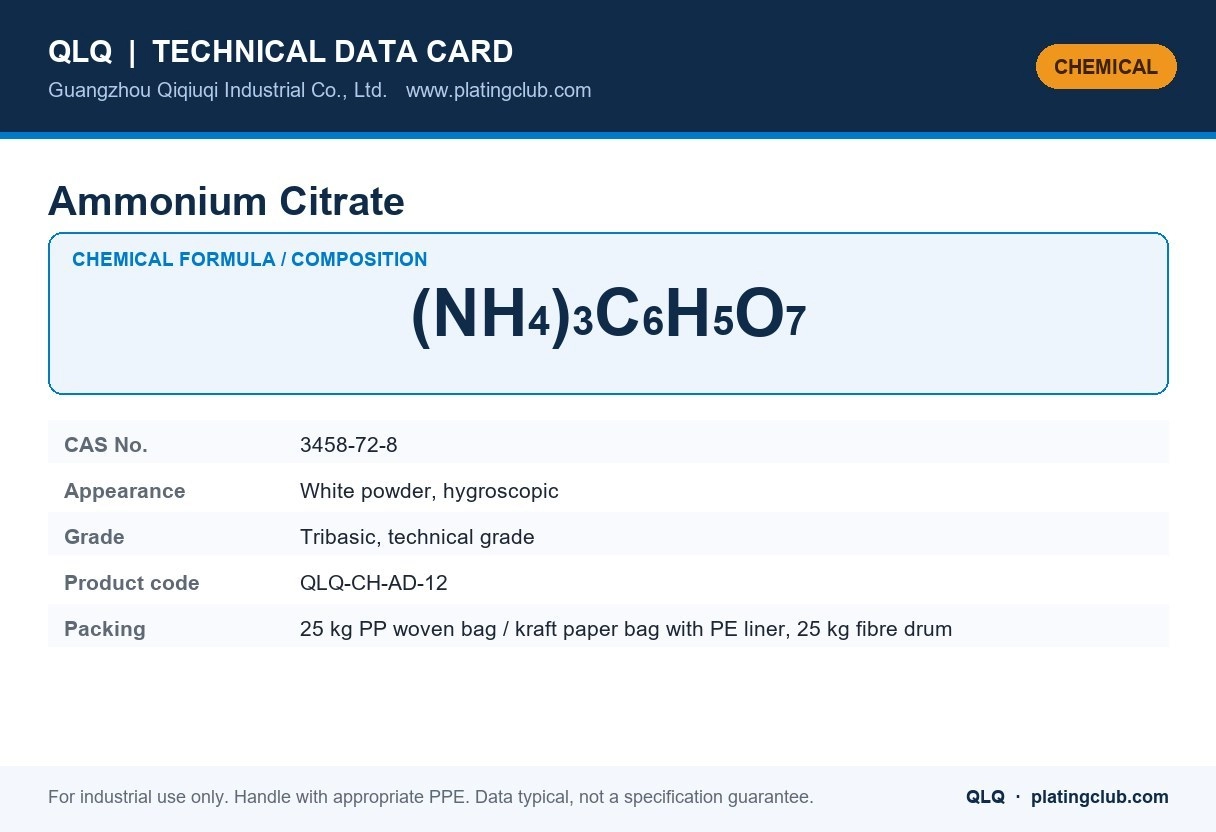
| Chemical formula | (NH4)3C6H5O7 |
| CAS number | 3458-72-8 |
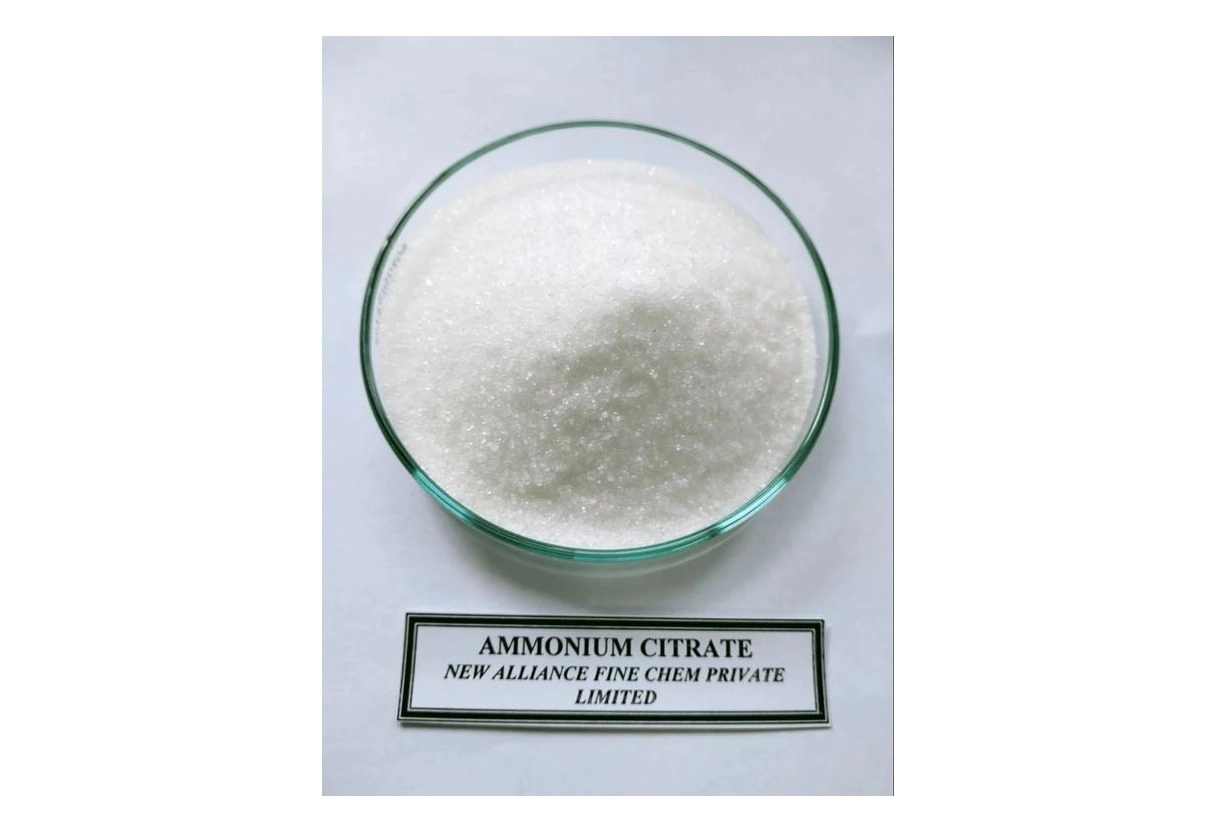
| Appearance | White powder, hygroscopic |
| Grade / type | Tribasic, technical grade |
| Standard packing | 25 kg PP woven bag or kraft paper bag with PE inner liner; 25 kg fibre drum |
What it is and what it does. Ammonium citrate is the mild chelant and buffering salt used in electroless plating, in cleaning formulations and in the colouring of copper alloys.
- White hygroscopic powder, very soluble; it holds metal ions in solution at near-neutral pH.
- Often used in electroless nickel and in mild alkaline cleaners where a gentle chelant is needed.
- Being a citrate it is readily biodegradable, unlike EDTA.
Typical Use in a Plating / Finishing Line
| Item | Typical guidance |
|---|---|
| Electroless nickel complexant | As specified by the bath formulation |
| Mild cleaner | 5-20 g/L |
| Note | Keep the container closed - the material picks up moisture readily |
Safety, Handling & Storage
| Item | Requirement |
|---|---|
| Hazard classification | Not classified as dangerous for transport in most cases; observe good industrial hygiene and dust control |
| Personal protective equipment | Dust mask, goggles and gloves for powder handling; general ventilation |
| Spill / first aid | Sweep up dry; material is a nuisance dust — avoid breathing the dust |
| Storage | Cool, dry, sealed store; keep bags closed, off the floor and away from moisture |
| Transport | Classified and packed according to IATA/IMDG for the hazard class; UN number and packing group stated on the shipping documents |
Quality Documents Shipped With Every Batch
| Document | Comment |
|---|---|
| COA (certificate of analysis) | Provided with the shipment; batch traceable to the production date |
| MSDS (safety data sheet) | Provided with the shipment; batch traceable to the production date |
| Packing list | Provided with the shipment; batch traceable to the production date |
| Commercial invoice | Provided with the shipment; batch traceable to the production date |
| Certificate of origin on request | Provided with the shipment; batch traceable to the production date |
Buyer Questions We Answer Every Week
| Question | Answer |
|---|---|
| Is it a buffer as well as a chelant? | Yes, the citrate part buffers in the mildly acidic to neutral range, which is convenient in electroless baths. |
| Why is the powder lumpy? | It is hygroscopic; break up the lumps and reseal the liner, there is no chemical problem. |
| Item | Typical Value |
|---|---|
| Chemical formula | (NH4)2HC6H5O7 (dibasic) / (NH4)3C6H5O7 (tribasic) |
| Assay (dibasic) | ≥ 99.0% |
| Nitrogen content | ≈ 12% (dibasic), ≈ 17% (tribasic) |
| Appearance | White crystals/granules, faint ammonia odour |
| Solubility (20°C) | ~ 1000 g/L in water |
| pH (1% solution) | ~ 4.5-5.5 (dibasic); higher for tribasic |
| Iron (Fe) | ≤ 0.001% |
| Heavy metals (as Pb) | ≤ 0.001% |
| Sulfate / Chloride | ≤ 0.02% / ≤ 0.005% |
| Standard packing | 25KG woven bag with PE inner liner |
How to Check Quality Before Loading a Batch
| Check | Method | Pass Criteria |
|---|---|---|
| Appearance & smell | Visual + nose | White uniform crystals, only faint ammonia smell; yellow tint or sharp smell = degradation or wrong salt |
| Solubility / clarity | Dissolve 50 g in 100 ml DI water | Clear, colourless solution; no residue |
| Assay & form | COA (alkalimetric titration + nitrogen) | ≥ 99%; confirm dibasic vs tribasic on the certificate - dosing is not interchangeable |
| pH of 1% solution | pH meter | 4.5-5.5 for dibasic; large deviation = wrong form or contamination |
| Coupon test | Top up a small EN or citrate-copper bath, plate test panel | Rate, pH stability and deposit match the reference within the run |
How QLQ controls it: ammonium citrate is bought on the certificate - form, assay and metals - because a tribasic bag dosed as dibasic shifts pH and complexant balance at once. Every lot is quarantined, pH-verified and coupon-tested before release, with the lot number retained for traceability.
How It Works in the Bath (Buffer + Complexant + Ammonium Source)
Electroless nickel and citrate-copper reactions generate acid as they run, and the pH window is narrow: drift a few tenths and rate, brightness or bath stability all move. Ammonium citrate buffers exactly in that working zone while its citrate keeps nickel and copper complexed and its ammonium ions stabilise the alkaline side of ammoniacal systems. In cyanide-free copper plating on zinc alloy, this combination is the whole trick - the citrate complex holds copper at a pH where zinc is not etched, so a copper strike can be laid down without the cyanide that classical zinc-alloy plating demanded.
| Application | Role of ammonium citrate | Typical working data (starting ranges) |
|---|---|---|
| Acid electroless nickel (buffer role) | pH buffer + co-complexant alongside the main complexant | 5-20 g/L with NiSO4 25-35 g/L, NaH2PO2 25-30 g/L, pH 4.6-5.4, 85-90°C |
| Ammoniacal EN (zinc alloy, aluminium work) | Ammonium + citrate keep Ni soluble at pH 8-10 without substrate attack | 20-40 g/L with ammonia pH control, 70-85°C |
| Cyanide-free citrate copper strike (Zn die-cast / Al) | Complexant holding copper at safe pH; ammonium stabilises the window | Reported starting range: Cu metal 10-20 g/L, ammonium citrate adjusted to citrate:Cu ≈ 2-3:1, pH 8.5-9.5, 20-40°C, 1-3 A/dm², 1-5 min strike |
| Buffered desmut / cleaning dips | Neutral-pH complexant removing oxide without etching | 10-50 g/L in water or mild-acid blends, 20-40°C |
Ammoniacal and citrate-copper systems are proprietary territory - the ranges above are published starting points to be validated on a Hull cell or test panel against the process supplier's specification before production use. The universal rule: dose by analysis, verify by coupon, change one variable at a time.
Common Problems & Fixes (Workshop Table)
| Problem | Root cause | Fix |
|---|---|---|
| EN pH drifts down fast between corrections | Buffer load too low for the tank's throughput | Raise ammonium citrate to the top of spec; check tank loading and temperature |
| Citrate-copper strike etches the zinc | Free ammonia too high or pH above ~9.5; bath too hot | Lower pH/ammonia, cool to 25-30°C, shorten strike time |
| Deposit slow or missing in recesses | Over-complexed copper - citrate ratio too high | Add copper to restore ratio; reduce complexant on next make-up |
| Ammonia smell strong around the tank | pH high and bath warm - ammonia volatilising | Ventilate; cap ammonia additions; keep pH at the bottom of window |
| Grey film on parts after desmut | Under-complexed metals re-depositing, or cleaner dragged in | Raise ammonium citrate in the dip; improve rinsing before it |
Handling & Safety
- Health: ammonium citrate is low-hazard, but dust irritates eyes and airways and the salt smells of ammonia when damp. Gloves and a dust mask are adequate; work in ventilated areas.
- Dissolving: dissolves readily in water. Do not mix the dry salt with strong caustic - ammonia gas is released from ammonium salts in contact with alkali.
- Heating: never heat ammonium citrate solutions strongly or boil dry - ammonium salts decompose and can spatter; heating tanks need fume extraction.
- Storage: keep bags sealed and dry; the salt slowly loses ammonia if stored wet or warm. Re-verify assay and pH on old stock before production use.
- Effluent: citrate is biodegradable but adds BOD/COD, and ammonia-nitrogen in waste is regulated - treat ammoniacal rinse water so ammonium stays inside your discharge consent.
- Incompatibility: keep away from hypochlorite and strong oxidizers (chloramine/chlorine gas risk) and from calcium-rich waters that can precipitate calcium citrate scale.
What It Does on Iron, Zinc Alloy, Copper and Stainless Steel Parts
| Substrate | How ammonium-citrate chemistry serves the part | Practice note |
|---|---|---|
| Iron / steel parts | Buffered EN deposits a uniform Ni-P barrier over complex steel geometry without current-density limits | Acid activate first; 10-25 μm for corrosion duty; confirm adhesion by bend test |
| Zinc alloy die-castings | The key substrate: citrate copper strike lays a cyanide-free copper base that acid baths cannot give without etching | Hold pH in the ammoniacal window, strike short and cool; copper 2-5 μm before nickel |
| Copper / brass | Complexed copper chemistry prevents stray immersion deposits in dips and supports electroless build on copper surfaces | Keep complexant balance; verify with a coupon before long runs |
| Stainless steel | Ammoniacal EN systems plate stainless (after activation) where acid EN would struggle on passive surfaces | Activate or nickel-strike stainless first; heat-test adhesion on the first batch |
FAQ
| Question | Answer |
|---|---|
| Dibasic or tribasic - what is the difference in the bath? | Two ammonium ions versus three. Tribasic is more alkaline and carries more nitrogen per bag; dosing one in place of the other shifts pH and buffer balance immediately. The certificate must state the form, and the bath must be dosed on the form it was designed for. |
| Can ammonium citrate replace sodium citrate in my EN bath? | Not without re-balancing. Ammonium ions are part of the chemistry - they stabilise pH differently and can accelerate or moderate rate depending on the system. Substitute only on the process supplier's advice, then re-verify rate and stability. |
| Is cyanide-free citrate copper production-ready for zinc die-cast? | Yes, as a documented route for strike and undercoat work, but it is not a plug-in replacement for a tuned cyanide line. Validate adhesion, coverage and corrosion on your own parts over a production trial before switching. |
| Does QLQ support citrate-copper and EN projects? | Yes - COA with every shipment and remote engineering support for electroless and cyanide-free copper work in 10+ countries, including trial design and defect diagnosis. |
Copper strike or EN bath not behaving? Send QLQ your analysis values and panels - engineers check pH balance, complexant ratio and substrate preparation and return a written fix. Contact us.
Shipping cost is based on weight. Just add products to your cart and use the Shipping Calculator to see the shipping price.We want you to be 100% satisfied with your purchase. Items can be returned or exchanged within 30 days of delivery.