

Spray Painting
Spray Painting groups every process in this section. The overview below shows all options side by side - click any card to open the full process page with working parameters, step-by-step procedure and QC checks.
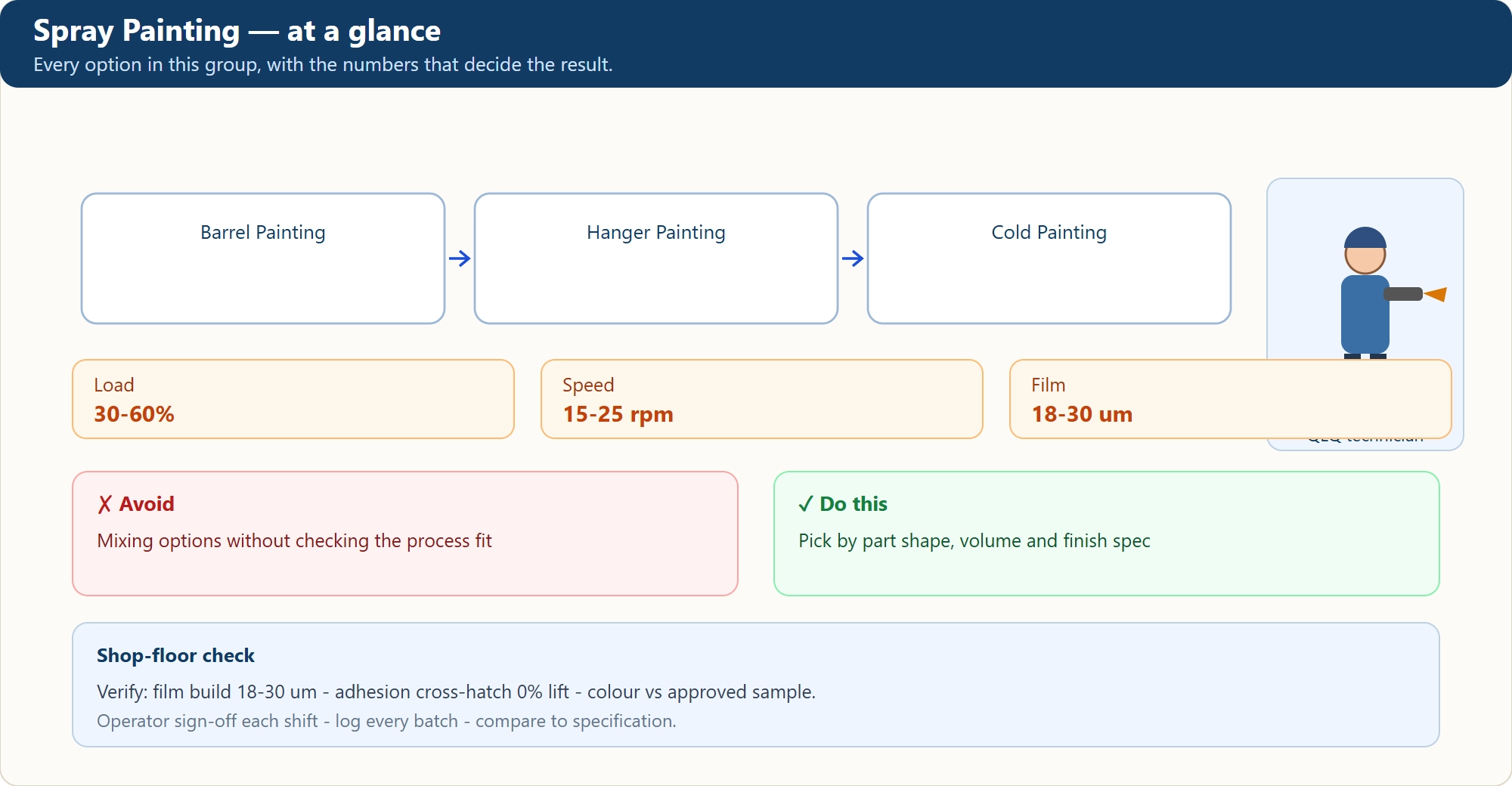
How to choose
Part shape, batch size and the finish specification decide the route. Every page in this group lists working parameters and the checks that must pass before shipping. Ask QLQ engineering if your case sits between two options.
Spray routes: what changes between them
| Route | Typical film build | Best for | Limit |
|---|---|---|---|
| Manual spray | 25-45 um per coat | Low volume, large parts, colour changes | Operator-dependent film build |
| Automatic line spray | 25-40 um | Repeating parts, high volume | Fixtures must be built per part |
| Electrostatic | 40-70 um | Metal parts with sharp edges | Faraday cages in recesses |
| Powder coating | 60-100 um | Durable outdoor surfaces | Thick film can hide fine detail |
Film build is measured on the finished part, not on the settings screen.
Defect → cause → fix
| Symptom | Cause | Fix |
|---|---|---|
| Orange peel | Viscosity too high or gun too far | Adjust thinner, move gun closer, check air pressure |
| Sags / runs | Over-application on vertical faces | Reduce pass overlap, split into two lighter coats |
| Colour mismatch | Wet film too thin over dark substrate | Build to hiding thickness, use primer |
| Pin holes | Solvent pop from thick coat | Flash off longer, apply thinner coats |
QC before packing
- Film thickness on 3 points per part (XRF or magnetic gauge)
- Adhesion: cross-hatch, no lifting
- Colour against approved chip under D65
- Gloss reading if specified
FAQ
How many coats for a colour change on dark substrate?
Expect three: primer for hiding, colour, then clear or top coat. Two coats over a dark base usually reads as a different shade.
Is powder always more durable?
For outdoor exposure, usually yes. For fine detail and thin walls, a liquid system gives better coverage with less film build.