
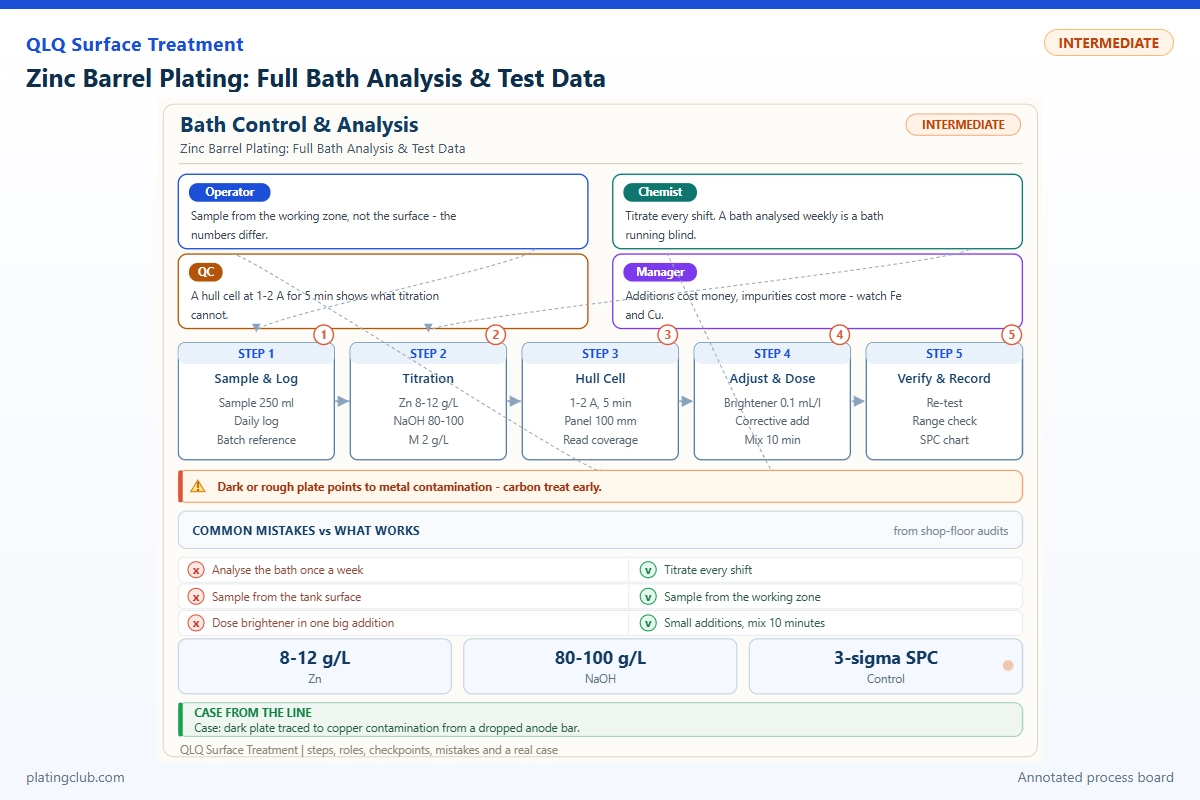
Zinc Barrel Plating: Full Bath Analysis & Test Data
A management-level zinc barrel plating review must connect bath chemistry, electrical contact, coating distribution and corrosion performance. A bright sample is not a release decision. The useful question is whether the entire load meets its specification, with traceable evidence and a repeatable correction process.
This guide covers acid potassium-chloride zinc deposition on compatible steel small parts. It does not describe plating zinc-alloy die castings: the substrate, activation and coating sequence must be qualified separately. QLQ's small-hardware experience supports barrel handling and fault isolation, but does not establish a zinc bath recipe or corrosion guarantee.
Working Data & Formula Notes
The following is an engineering barrel make-up example derived from the COLSID K-250 technical bulletin. Its barrel limits are zinc metal 19–30 g/L, chloride 120–135 g/L, boric acid 19–30 g/L, wetter 3–5% by volume, pH 4.8–5.9 and temperature 21–48°C. Additives are proprietary, not interchangeable with another supplier's products.
| Component | Range | Typical | Function | Replenishment |
|---|---|---|---|---|
| Zinc chloride, ZnCl2 | 39.6–62.5 g/L equivalent | 50 g/L | Zinc source | Analyze; account for anode dissolution and dragout. |
| Potassium chloride, KCl | Coupled to total chloride | 220 g/L | Conductivity | Calculate from chloride deficit, not conductivity alone. |
| Boric acid, H3BO3 | 19–30 g/L | 25 g/L | Cathode buffering | Replace measured losses. |
| K-250 WETTER | 30–50 mL/L | 40 mL/L | Carrier/wetting package | Verify with Hull-cell response. |
| K-250 BRIGHTENER | 1 mL/L published initial charge; no concentration range specified | 1 mL/L initially | Brightness package | Published consumption: 0.189–0.252 L/1,000 Ah. |
| DI water and pH adjustment | Final volume; pH within qualified limits | Balance; target pH 5.2 | Solvent/acidity | Restore volume before analysis; controlled correction. |
The selected salt charges are calculated, not a supplier-issued barrel recipe. Assuming pure anhydrous salts, zinc metal = 0.4797 × ZnCl2; total chloride = 0.5203 × ZnCl2 + 0.4755 × KCl. The example gives approximately 24.0 g/L zinc and 130.6 g/L chloride. Adjust for assay, hydration and actual working volume. Approve a pilot load before production.
Never vary KCl and ZnCl2 independently without recalculating chloride. For a 1,000 L bath, raising zinc metal by 2 g/L requires approximately 4.17 kg pure ZnCl2; this also adds 2.17 g/L chloride. A zinc correction can therefore exhaust the chloride margin.
Bath Analysis That Supports a Decision
Sample a well-mixed bath at its marked working level before making additions. Assign a sample ID linking tank, time, temperature, operator, last replenishment and cumulative ampere-hours. Retain a comparison sample when diagnosing a sudden change. Do not sample directly beside a dosing outlet.
Measure zinc using a validated complexometric method; chloride using a validated argentometric or instrumental method; and boric acid using the supplier-approved method. Run standards, blanks and duplicates. For an EDTA method with verified 1:1 zinc stoichiometry, zinc in g/L = VEDTA × MEDTA × 65.38 / Vsample, with both volumes in mL and any dilution factor applied separately. Interference control belongs in the laboratory SOP.
Check pH with a calibrated meter at a defined measurement temperature. Trend temperature and current continuously where practical. Use conductivity as an alarm signal, not a selective chloride assay. Analyze iron and relevant heavy metals when staining, skips or unexplained Hull-cell deterioration appears; establish contamination limits through supplier trials rather than a universal ppm rule.
A fixed Hull-cell protocol should specify volume, panel preparation, current, time, temperature and agitation. Photograph every panel under identical lighting. A panel shows bath response under controlled conditions; it cannot certify barrel contact or recess thickness.
Normal Fluctuation Bands Versus Danger Thresholds
These narrower bands are proposed management controls for the example bath, not published defect-onset constants. Crossing an action limit means stop new loads, verify the measurement and obtain technical authorization. Existing product requires disposition based on its actual results. Do not borrow a pH threshold from another zinc chemistry.
| Parameter | Normal fluctuation band | Danger/action threshold | Response |
|---|---|---|---|
| Zinc metal | 22–26 g/L | <19 or >30 g/L | Repeat assay; assess metal/chloride balance. |
| Total chloride | 125–132 g/L | <120 or >135 g/L | Check dragout, volume and salt dosing. |
| Boric acid | 23–27 g/L | <19 or >30 g/L | Confirm assay and dissolution. |
| pH | 5.0–5.4 | <4.8 or >5.9 | Verify calibration; controlled correction. |
| Temperature | 25–32°C | <21 or >40°C site stop | Check cooling and sensor; 40°C is a conservative site limit. |
| Barrel fill | 35–45% usable volume | <30 or >50% | Reweigh; verify movement and contact. |
| Barrel rotation | 8–10 rpm qualified starting band | Outside approved recipe; provisional >15 rpm stop | Measure actual speed; inspect impact damage. |
The QLQ IMA barrel note gives general handling references of 30–50% fill and 8–15 rpm, not zinc-specific guarantees. Fragile, nesting or interlocking parts may require a different validated recipe. Freeze the approved mass, part family and speed together; percentage fill alone does not describe the load.
Published Experimental Test Data
The EPA/Battelle Aeroquip report, Table 8 and accompanying discussion provides real barrel-plated zinc corrosion results. Four groups each contained six specimens. The table below summarizes observed endpoints without inventing thickness or hardness values.
| Specimen group | Test condition | Thickness / hardness | White corrosion at 96 h | Red rust at 360 h | Extended observation |
|---|---|---|---|---|---|
| A; six parts | 5% salt spray; ASTM B117-90; historical zinc/chromate system | Not established in this summary | None | None | One specimen showed red rust at 432 h. |
| B; six parts | Same test protocol | Not established in this summary | None | None | No red rust at 504 h. |
| C; six parts | Same test protocol | Not established in this summary | None | None | Red rust present by 504 h. |
| D; six parts | Same test protocol | Not established in this summary | None | None | No red rust at 504 h. |
These historical results are not transferable to modern trivalent passivation, another part geometry or another coating thickness. Absence of rust at test termination is a censored result, not a measured failure time. Salt-spray hours are not outdoor service-life years.
For local validation, compare baseline and corrected loads using the same part family, sampling plan, passivation and conditioning interval. Measure coating thickness at specified accessible and recessed locations using a geometry-qualified method. Record minimum, mean, spread and failures, not just the average. Add adhesion results and corrosion observations at the customer's required intervals. Use microhardness only with a justified preparation and indentation method; thin zinc on steel can give substrate-dominated readings.
Two Reference Cases: What Management Should Learn
Case 1: Barrel groups pass early checks but diverge later
The published barrel comparison above demonstrates why an early common pass cannot establish equal endurance. A manager should preserve the individual group identity throughout extended exposure. For a current line, connect each specimen to load recipe, thickness map and post-treatment lot before choosing which process stage to investigate. The report does not establish the cause of the later divergence.
Case 2: Independent laboratories and missed observation intervals
In the same EPA report's rack-plated comparison, the two laboratories identified three of 48 specimens that did not meet the 360-hour red-rust requirement. An observation gap also left one specimen's condition at 360 hours uncertain. This is a separate reference case about inspection scheduling, not barrel chemistry. Arrange weekend coverage or explicitly record interval uncertainty; never silently replace the required observation with a later reading.
Engineer Notes
- Separate contact from chemistry. If the reference panel is acceptable but barrel parts skip, isolate power before inspecting danglers, contact buttons, cables and perforations. Verify the contact system before authorizing additives.
- Change one variable. Run a comparison load at the approved mass and speed; change only the suspected factor. Keep pretreatment, plating charge and passivation fixed. Otherwise the trial cannot identify the effective correction.
- Dose from a verified deficit. Calculate addition mass = concentration deficit × working volume / active fraction. Confirm units and require a second-person check; add in staged increments and reanalyze after mixing.
- Normalize electrical data. Record charge per load and estimated surface area. At 100% efficiency, zinc mass is approximately 1.22 g/Ah; estimate actual efficiency from a qualified measurement, not visual brightness.
- Investigate contamination before treatment. Use supplier-supervised bench trials before carbon, oxidation or metal-removal treatment. Do not make simultaneous large additions to an operating production tank.
- Protect post-treatment comparability. Record rinse condition, passivation lot, dwell, drying and conditioning. An unchanged zinc analysis cannot explain every corrosion failure.
- Close the corrective-action loop. Release corrected production only after agreed first-off checks. Hold affected lots from the last verified acceptable condition and document the disposition owner.
Shift Checks
| Shift stage | Check item | Frequency | Acceptance standard | Record |
|---|---|---|---|---|
| Before shift | Volume, pH, temperature; meter calibration | Every start and restart | Approved bands; calibration accepted | Tank sheet and calibration log |
| Before shift | Zinc, chloride, boric acid; reference panel | Daily minimum; more after major changes | Approved assays and panel baseline | Laboratory report and panel image |
| Before shift | Contacts, barrel, filtration and exhaust | Every shift | Inspection passed; no unresolved safety defect | Maintenance checklist |
| During shift | Mass, speed, current and accumulated charge | Every load | Within validated part-family recipe | Load traveler and rectifier data |
| During shift | pH and temperature | Hourly; continuously where instrumented | Normal bands; no unresolved alarm | Trend and action log |
| During shift | Thickness, appearance and adhesion | First-off, after correction, sampling plan | Customer drawing and approved inspection plan | Location-level measurement report |
| After shift | Replenishment reconciliation and contamination trend | Every handover | All additions authorized and traceable | Chemical ledger and exception list |
| After shift | Retained specimens and corrosion schedule | Each qualification lot | Correct identification and observation coverage | Test register and handover signature |
Management should review first-pass yield, minimum-thickness failures, chemical consumption per accepted area and unresolved holds weekly. Investigate sustained drift while values remain inside limits. A stable average can conceal widening load-to-load variation.
FAQ: Questions Technicians Ask an AI Assistant
These are practical question formulations, not verified quotations from customer correspondence.
“My zinc barrel bath analysis is normal, but recessed areas are thin. What should I check first?”
Verify thickness measurement and compare actual load mass, contact condition, charge and rotation with the approved recipe. Check nesting and restricted solution exchange. Use the reference panel to separate bath response from barrel mechanics. Do not increase current until contact and distribution are understood.
“Can I release a batch because it looks bright and passed 96 hours of salt spray?”
Only if every applicable acceptance requirement is met. Brightness does not establish minimum thickness, adhesion or the required red-rust endpoint. Specify white corrosion and red rust separately, retain the test conditions and follow the customer's approved release rules.
“How much zinc chloride should I add after the zinc assay falls?”
First confirm working volume and repeat the assay. Convert the metal deficit using salt assay, then calculate its chloride contribution. Check anode performance and dragout. If chloride would exceed its limit, obtain a supplier-approved balancing plan instead of blindly dosing the metal deficit.
Source Boundaries and Traceability
QLQ handling and diagnostic references: E:/Video-factory/knowledge_base/QLQ-Obsidian-Vault/, IMA company-library split note 019, “Barrel Plating”; Surface Treatment notes “Rack and Barrel Plating” and “Plating Defect Analysis.” English labels identify the consulted local notes. They do not contain the published zinc corrosion data.
The supplier bulletin supports chemistry reference limits; EPA supports historical experimental observations. Calculated make-up values, narrower control bands, shift frequencies and decision procedures are engineering proposals requiring local approval. No customer outcome, missing hardness value or QLQ zinc process approval is implied.
What Would You Like to Solve?
Send the substrate, part geometry, load mass, bath analyses, thickness map, defect photographs and required corrosion endpoint to [email protected]. QLQ can help frame equipment, handling and process-support questions. For planning context, review surface-treatment line equipment, chemicals and support. Start with the observed failure and evidence, not a promise of universal bath settings.