
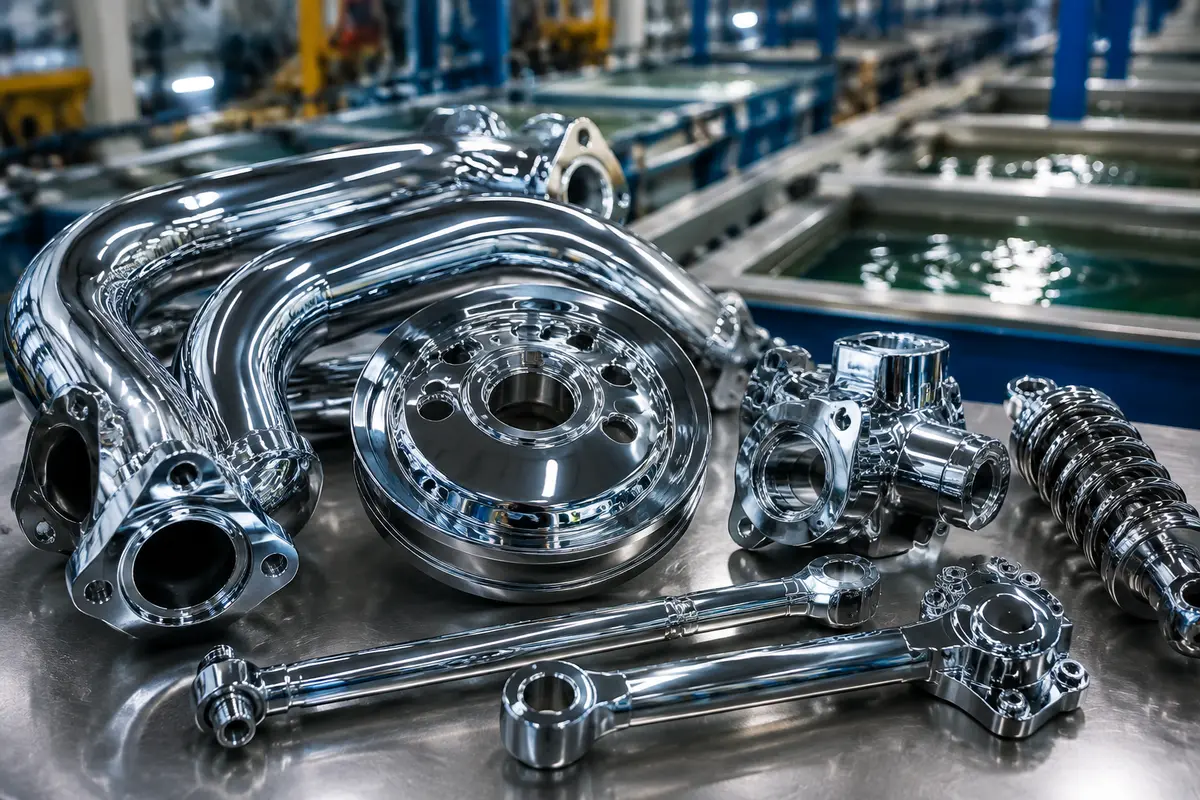
Why Chrome Plating Selection Matters
When sourcing chrome-plated metal parts, the single most important decision you'll make isn't about price — it's about which type of chrome plating your application actually requires. Order decorative chrome for a hydraulic cylinder rod, and you'll face premature wear within weeks. Specify hard chrome for a cosmetic trim piece, and you'll overpay for properties you don't need.
This guide breaks down the two primary industrial chrome plating processes — their technical differences, performance characteristics, and real-world application scenarios — so you can write specifications that match your requirements from day one.
Hard Chrome Plating (Industrial / Engineering Chrome)
Process Overview
Hard chrome plating — also called engineering chrome or industrial chrome — deposits a thick layer of chromium directly onto a metal substrate (typically steel, cast iron, or stainless steel) through electrodeposition in a chromic acid bath. Unlike decorative chrome, hard chrome is applied in substantial thicknesses ranging from 0.025 mm to 0.5 mm (1–20 mils), with some heavy-build applications exceeding 1 mm.
Key Performance Properties
| Property | Value |
|---|---|
| Hardness | 850–1,100 HV (68–72 HRC) |
| Friction Coefficient | 0.16 (against steel, lubricated) |
| Service Temperature | Up to 400°C |
| Corrosion Resistance | Moderate (micro-cracked structure) |
| Wear Resistance | Excellent (Taber wear index < 2 mg/1,000 cycles) |
Primary Industrial Applications
- Hydraulic cylinder rods — wear resistance under reciprocating motion
- Piston rings & engine components — high-temperature scuff resistance
- Mold & die surfaces — release properties and abrasion protection
- Printing & paper mill rolls — uniform surface with extended service life
- Shafts, pins & bearing journals — dimensional restoration plus surface hardening
- Mining & construction equipment — heavy-duty abrasive environment protection
Decorative Chrome Plating (Bright Chrome)
Process Overview
Decorative chrome plating applies an extremely thin chromium layer — typically 0.05–0.5 μm (0.002–0.02 mils) — over a nickel undercoat. The nickel provides corrosion protection and brightness; the chrome flash adds tarnish resistance and that signature blue-white reflective finish. Modern decorative chrome increasingly uses trivalent chromium (Cr³⁺) baths for environmental compliance, replacing traditional hexavalent (Cr⁶⁺) processes.
Typical Layer Structure
A quality decorative chrome system uses a multi-layer approach:
- Base metal — steel, zinc die-cast, brass, or aluminum
- Copper strike (optional) — improves adhesion on zinc/steel substrates
- Semi-bright nickel — 8–15 μm — primary corrosion barrier
- Bright nickel — 5–10 μm — creates reflective base for chrome
- Micro-porous or micro-cracked nickel (optional) — enhances CASS corrosion performance
- Chrome flash — 0.1–0.3 μm — final decorative finish
Primary Applications
- Automotive trim & exterior components — grilles, emblems, door handles
- Plumbing fixtures & bathroom hardware — faucets, shower heads, towel bars
- Furniture hardware — chair bases, table legs, decorative fittings
- Consumer electronics — appliance panels, audio equipment details
- Lighting components — reflectors, decorative housings
Head-to-Head Comparison: Hard Chrome vs Decorative Chrome
| Criterion | Hard Chrome | Decorative Chrome |
|---|---|---|
| Thickness | 25–500 μm | 0.05–0.5 μm |
| Hardness (HV) | 850–1,100 | 800–1,000 (thin layer) |
| Undercoat Required | No (direct to substrate) | Yes (nickel + copper layers) |
| Wear Resistance | Excellent | Poor (cosmetic only) |
| Corrosion Resistance | Moderate (micro-cracked) | Excellent (nickel barrier) |
| Surface Finish | Matte to semi-bright | Mirror-bright, blue-white |
| Dimensional Buildup | Yes (salvage/restoration) | No (negligible thickness) |
| Typical Cost (relative) | $$$ (thicker = costlier) | $$ (multi-layer process) |
| Post-Plate Grinding | Often required | Not required |
| Common Chrome Type | Hexavalent (Cr⁶⁺) | Trivalent (Cr³⁺, modern) |
Quality Standards & Testing Specifications
ASTM B650
Standard specification for electrodeposited engineering chromium coatings on ferrous substrates. Covers thickness, hardness, adhesion, and porosity testing requirements.
ASTM B456
Standard specification for electrodeposited coatings of copper plus nickel plus chromium on various substrates. Defines service condition numbers (SC1–SC5) for decorative applications.
ISO 6158
International standard for electroplated coatings of chromium for engineering purposes. Harmonizes global specification requirements.
CASS Test (ASTM B368)
Copper-Accelerated Acetic Acid Salt Spray test. The gold standard for evaluating decorative chrome corrosion performance — typically 22–66 hours depending on service condition.
Pro tip: When reviewing supplier quality reports, verify that hardness testing follows ASTM E384 (Knoop/Vickers microhardness) and that thickness measurement uses ASTM B487 (microscopic cross-section method) or ASTM B568 (X-ray fluorescence) — not magnetic gauges, which are unreliable on chrome.
Environmental & Regulatory Considerations
The chrome plating industry is undergoing significant regulatory transformation:
- EU REACH Regulation — Chromium trioxide (CrO₃) authorization has been increasingly restricted since 2017. Hard chrome platers must apply for specific-use authorization and demonstrate exposure control.
- US EPA Chromium Electroplating NESHAP — Mandates stringent emission controls for hexavalent chromium, including surface tension suppressants (fume suppressants) and HEPA-filtered ventilation.
- Trivalent Chrome Adoption — Decorative applications have largely transitioned to Cr³⁺ baths. Industrial/hard chrome Cr³⁺ processes are emerging but currently cannot match hexavalent hardness and build rates in all applications.
Suppliers with ISO 14001 environmental management certification and documented fume suppression systems demonstrate regulatory readiness that protects your supply chain continuity.
Specification Checklist for Buyers
Before submitting an RFQ for chrome-plated parts, confirm these five points: