
"Can you pass 48 hours of salt spray?" is the single most common quality question hardware buyers ask — and the most common source of quotation confusion. The honest answer is always the same shape: it depends on the base metal and the plating system, not on one number. This guide gives the working correlations we use daily for zipper hardware and small die-cast parts, so you can specify thickness and test hours that actually match.
First, Fix the Test Name
Neutral salt spray (NSS) per ISO 9227 is the standard most buyers mean (equivalent to ASTM B117). When you request a quote, specify:
- The test: ISO 9227 NSS (or CASS/acetic if your spec says so — they are much more aggressive)
- The base material: brass, zinc alloy, steel
- The plating system: single nickel, double-layer nickel, copper + nickel + topcoat, or zinc + passivation
- What counts as failure: red rust? white rust? loss of adhesion?
The same plating passes different hour counts on different base metals — never accept a salt-spray promise that omits the substrate. The identical nickel layer runs about one grade lower in life on zinc alloy than on brass, because the substrate changes the corrosion mechanism.
Working Correlations for Decorative Plating ( NSS,经验区间)
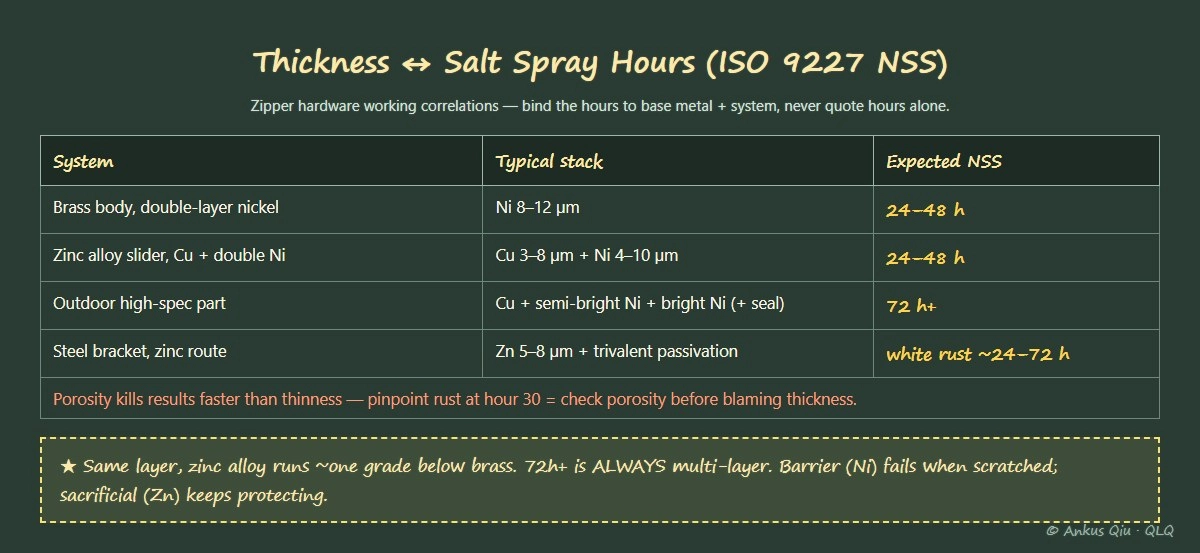
| System (typical for zipper hardware) | Typical thickness stack | Expected NSS result |
|---|---|---|
| Brass body, double-layer nickel | 8–12 µm Ni | 24–48 h |
| Zinc alloy slider, Cu + double Ni | Cu 3–8 µm + Ni 4–10 µm | 24–48 h |
| High-specification outdoor part | Cu + semi-bright Ni + bright Ni (+ topcoat) | 72 h+ |
| Anti-oxidation topcoat added | + organic seal 0.1–0.5 µm | Extends the above |
| Steel bracket, zinc + passivation | Zn 5–8 µm + trivalent passivation | White-rust resistance from ~24–72 h, depending on passivation |
Notes on the table:
- Decorative nickel ranges: copper underlayer 3–8 µm, nickel 4–10 µm, top plate 0.1–0.5 µm. Functional thick nickel runs 15–25 µm.
- 72 hours and beyond is a multi-layer job: copper + semi-bright nickel + bright nickel, with porosity under control. A single bright nickel layer will not get there on zinc alloy.
- These are experience intervals from line practice; final numbers belong to third-party test reports, not to quotations.
Why "More Nickel" Is Not Always the Answer
Nickel protects as a barrier layer: it shields the base metal while intact, but a scratch through the layer exposes bare metal and corrosion starts there. Zinc works differently — it is a sacrificial anode: even when scratched, zinc corrodes preferentially and keeps protecting the steel underneath.
So for an outdoor bracket that will be scratched in service, zinc + passivation often outlasts a thicker decorative nickel stack. For an indoor decorative slider, bright nickel wins on appearance and cost. Specify by service environment, not by "which is premium".
The Porosity Trap
Porosity kills salt-spray results faster than thinness does. Pores in the nickel layer are tiny channels to the substrate; each one becomes a corrosion cell in the chamber. Multi-layer systems (semi-bright over bright) work partly because layer boundaries interrupt these channels. If your 72-hour test fails at hour 30 with pinpoint rust, ask for a porosity check before blaming thickness — the deposit may be thick but porous.
What to Put in Your RFQ (copy this)
1. Base material and part photos/drawings
2. Target test: ISO 9227 NSS, X hours, failure definition
3. Service environment: indoor / outdoor / coastal
4. Appearance class: mirror bright / satin / color-plated
5. Third-party verification: which lab, who pays
Suppliers who answer all five points in one quotation are the ones who have actually run the test.
FAQ
Q: Can you guarantee 96 hours on a zinc alloy slider?
A: With a full copper + semi-bright + bright stack plus seal, 96 h is achievable but must be validated on your part geometry — recesses plate thinner and fail first. We quote test hours after a trial, never from a catalog.
Q: Our current supplier passes 24 h but parts rust in the warehouse. Why?
A: Salt spray measures chloride exposure, not storage corrosion. Warehouse rust usually points at residual salts from rinsing or chloride-contaminated surface — check final rinse water quality and drying, and ask about a seal or anti-oxidation topcoat.
Q: Is CASS the same as NSS with more hours?
A: No — CASS (copper-accelerated acetic acid spray) is far more aggressive per hour and is used mainly for decorative chromium systems. Never compare a CASS hour count to an NSS hour count.
About the author: Ankus Qiu — senior process engineer at QLQ (Guangzhou QLQ Enterprise Co., Ltd.), 25 years plating zipper sliders and hardware. QLQ runs in-house corrosion testing and supplies complete plating lines and chemical systems; ISO 9001, exports to 70+ countries. Test hours quoted per part geometry and validated by third-party labs on request.