
If you ship plated hardware to the EU — buttons, buckles, zipper sliders, bag fittings — your buyer's compliance team will eventually send you one line that stops quotations cold: "Confirm your products are REACH-compliant; hexavalent chromium (Cr VI) is restricted." This guide explains what Cr VI restriction means for electroplated hardware, what the alternatives actually are, and the exact documents to have ready before the buyer asks.
Why Hexavalent Chromium Is the Problem
ChromiumVI compounds are highly toxic, carcinogenic, and strictly limited under the EU REACH regulation (Annex XVII entry 47 and related restrictions; the SVHC candidate list is updated periodically by ECHA). Historically, two things in our industry relied on Cr VI:
1. Chromate conversion coatings on zinc-plated parts (the classic yellow/olive iridescent passivates)
2. Some color-treatment chemistries in decorative plating
A zinc-plated bracket with yellow passivation from an old-school chromate line can fail an SVHC screen — not because of the zinc, but because of residual hexavalent chrome in the conversion layer.
The Substitutes That Actually Work
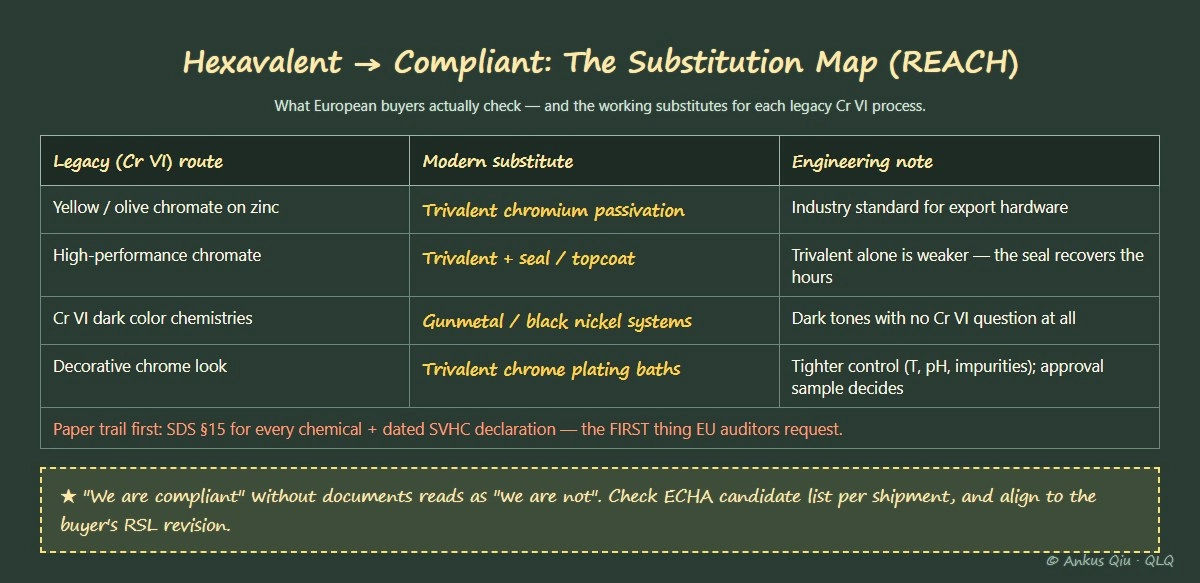
| Old (Cr VI) route | Modern substitute | Practical notes |
|---|---|---|
| Yellow/olive chromate on zinc | Trivalent chromium passivation | Industry standard for export hardware; blue/clear and black trivalent systems are routine |
| High-performance chromate | Trivalent + topcoat/seal | Trivalent alone is less corrosion-resistant than hexavalent; add a seal to recover hours |
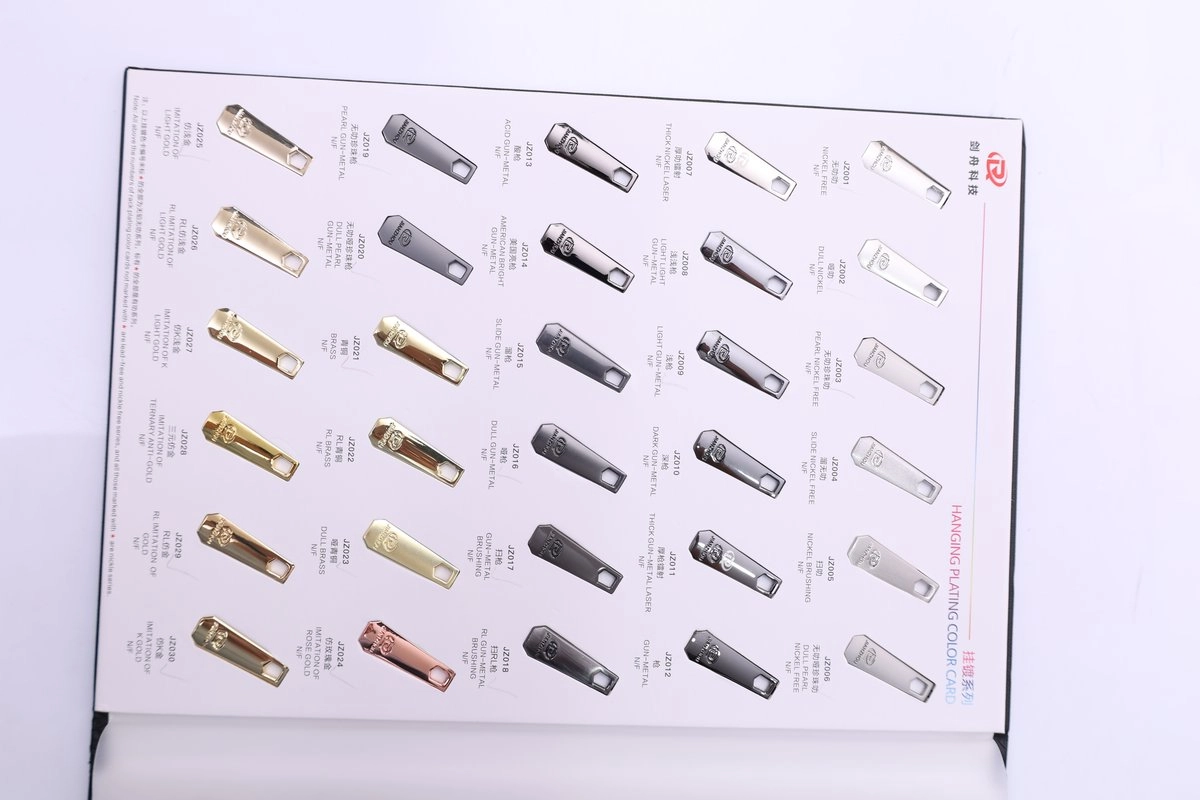
| Cr VI color chemistries | Color-plating systems (gunmetal/black nickel, antique finishes) | Achieve dark decorative tones without chromium VI chemistry |
| Hard decorative chrome look | Trivalent chrome plating processes | Available from major chemical suppliers; color slightly less "white" — approval sample decides |
Two engineering truths buyers appreciate:
- Trivalent passivation + a sealed topcoat is the workhorse export combination for zinc-plated hardware today.
- For dark decorative tones, gunmetal / black-nickel systems avoid the chromium question entirely — which is why they dominate modern zipper hardware styling.
Your Compliance Paper Trail (have these before the buyer asks)
1. SDS Section 15 for every chemical you supply or use in production — suppliers declare SVHC status there. Buy only from chemical suppliers who provide current, revision-dated SDS.
2. SVHC declarations for the finished product, checked item-by-item against the current ECHA candidate list (it is updated regularly; "we were compliant last year" is not an answer).
3. Test reports: SVHC screening by a third-party lab on representative samples.
4. Downstream textiles/apparel buyers frequently apply their own RSL (Restricted Substances List) and OEKO-TEX requirements on top of REACH — align with the buyer's RSL revision, not just the law.
Practical rule from our export desk: the first thing a European auditor asks for during a factory visit is SVHC confirmation documents — not certificates of the machinery. Prepare the folder in advance; "we are compliant" without documents reads as "we are not".
Does Trivalent Cost More?
Yes, modestly — trivalent passivation chemistry costs more per liter than legacy chromate, and trivalent chrome plating baths need closer control (bath temperature, impurities, pH window are tighter). But the alternative — losing an EU account over a failed SVHC screen — costs more. Many buyers now specify trivalent in their RSL regardless of regulation, so the market has largely absorbed the premium.
FAQ
Q: Our zinc parts pass 48h NSS with hexavalent yellow passivation. Will trivalent match that?
A: Trivalent alone typically gives less corrosion resistance than hexavalent chromate; the standard answer is trivalent + sealed topcoat to recover the hours. Validate on your part, not on a data sheet.
Q: Is "chrome-free" the same as "trivalent"?
A: No. Chrome-free routes exist (e.g., passivation chemistries based on titanium or cobalt systems from various suppliers). Trivalent contains chromium in the +3 oxidation state, which is the compliant form. Check your buyer's spec — some demand chrome-free, others accept trivalent.
Q: We only sell to the US. Does REACH matter?
A: US federal law does not enforce REACH, but major US retailers and brands enforce their own RSLs that mirror it — and California Prop 65 listings include Cr VI compounds. If your customer sells on Amazon or to retail chains, expect the same paperwork.
Q: What single document prevents the most audit friction?
A: A current, supplier-issued SDS with Section 15 properly completed for every chemical on your line, plus a dated SVHC declaration for your finished parts. Auditors forgive a lot when the paper trail is organized.
About the author: Ankus Qiu — senior process engineer at QLQ (Guangzhou QLQ Enterprise Co., Ltd.), 25 years plating zipper sliders and hardware for export. QLQ supplies trivalent-compatible plating lines and in-house chemical systems; ISO 9001, exports to 70+ countries. SVHC lists and regulatory interpretations evolve — always verify against the current ECHA publication and your buyer's RSL revision.