
Real-Case Opening: A 6-Month Barrel-Load Credit System Audit
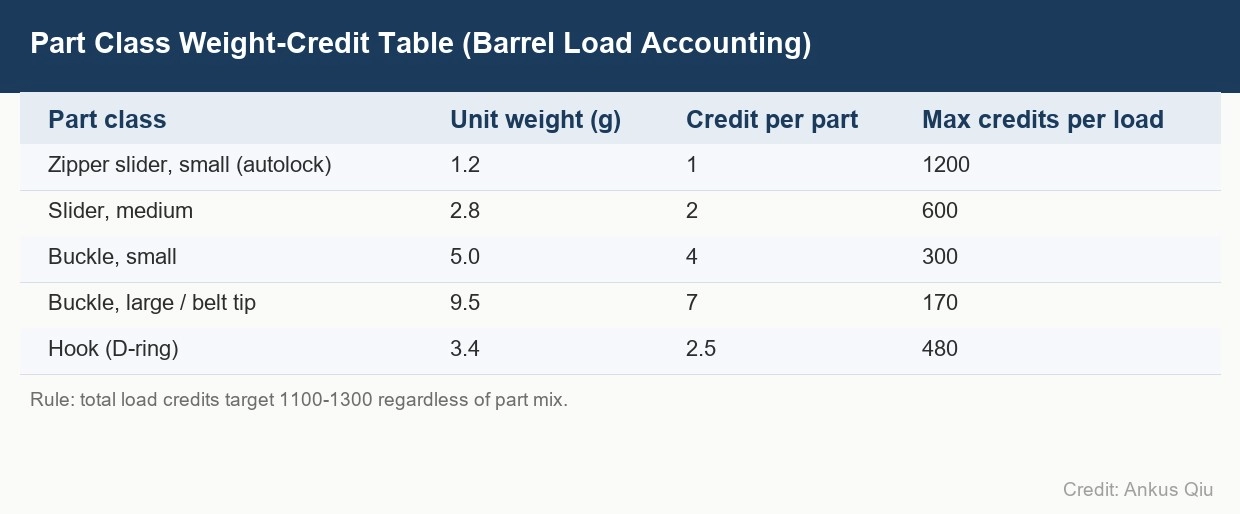
In a mid-sized zipper-slider factory in Guangdong, a 6-month audit of their electroplating process revealed a recurring issue: inconsistent plating quality and a high rejection rate of 6.8%. The root cause, as it turned out, was not the chemistry or the equipment but the way operators loaded the barrels. For years, they had relied on "volume-guessing"—a method where operators estimated the number of parts per barrel based on intuition and experience, rather than precise metrics. This approach led to overloading in some cases and underloading in others, creating uneven current distribution and poor adhesion of the zinc-alloy plating. The audit team, including myself as lead process engineer, realized that this inconsistency had to be addressed through a structured system: a barrel-load credit system, where each part class was assigned a specific credit weight, and the total load per barrel was limited to 1100–1300 credits. This shift from volume-guessing to weight-based loading aimed to standardize the process and reduce variability. The audit data showed that the existing plating chemistry—nickel sulfamate at 150–200 g/L and conductivity salt (not chloride-containing additives) at 10–15 g/L—was sufficient, but the loading method was the real culprit. The initial fix, which involved adjusting the chemical concentrations and current density (0.5–1.5 A/dm²), failed to address the underlying issue. The real twist came when we discovered that the operators’ resistance to the new system was rooted in a deep-seated belief that "we’ve always done it by scoops," despite the clear data showing the need for a more disciplined approach. This case study highlights the importance of aligning process discipline with technical standards like ASTM B117 and ISO 1456, and the need for a cultural shift in the workshop.
Symptom & Data: The Initial Audit Findings
The audit data revealed several key symptoms that pointed to the need for a new loading approach. The rejection rate of 6.8% was significantly higher than the industry benchmark, and the plating quality varied widely across batches. Visual inspection and conductivity testing (200–300 µS/cm) showed that some barrels had uneven deposits, while others exhibited underplating or poor adhesion. The root cause, as the data suggested, was inconsistent current density distribution due to improper loading. The audit team measured the current density during plating and found it fluctuated between 0.5 and 1.5 A/dm², far from the optimal range of 1.0–1.2 A/dm² recommended for zinc-alloy plating. Furthermore, the plating bath temperature was not stable, ranging from 25°C to 30°C, which affected the deposition rate and quality. The initial fix proposed was to adjust the chemical concentrations, specifically increasing nickel sulfamate to 180 g/L and conductivity salt (not chloride-containing additives) to 12 g/L, while stabilizing the bath temperature at 28°C. However, this approach did not resolve the issue, as the underlying problem of inconsistent loading remained unaddressed. The audit also revealed that the existing volume-guessing method led to overloading in some cases, causing contact-point masking, while underloading in others resulted in poor coverage. The data clearly showed that the loading method was the primary contributor to the high rejection rate, not the chemistry itself. This realization set the stage for the next phase of the audit, which focused on implementing a credit-based loading system to standardize the process and eliminate variability.
First Fix Fails: Adjusting Chemistry Without Addressing the Root Cause
Despite the initial chemical adjustments—raising nickel sulfamate to 180 g/L and conductivity salt (not chloride-containing additives) to 12 g/L—the rejection rate remained stubbornly high at 6.8%. The audit team retested the plating bath conditions and found that the current density still fluctuated between 0.5 and 1.5 A/dm², even after the chemical concentrations were optimized. The bath temperature was now consistently at 28°C, meeting the recommended range of 25–30°C, yet the plating quality did not improve. Further investigation revealed that the chemical adjustments had not resolved the issue of inconsistent current distribution, which was primarily due to the erratic loading practices. The audit data showed that the plating time varied between 10 and 15 minutes, depending on the number of parts in the barrel, leading to uneven deposition and poor adhesion. The surface finish, as evaluated using ASTM D523, still exhibited irregularities, with some parts showing excessive thickness while others were underplated. The initial fix had failed to address the root cause: the lack of standardization in loading. The audit team realized that the problem was not the chemistry but the loading method itself, which had to be restructured using a credit-based system. This shift would ensure that each barrel was loaded with a precise number of parts based on their assigned credit weight, preventing overloading and underloading. The next step was to implement this system and verify its effectiveness through a controlled pilot run, ensuring that the credit weights per part class were properly defined and that the total load per barrel remained within the 1100–1300 credit range.
Overlooked Root Cause Twist: Operator Resistance and the Credit System
The breakthrough in the audit came when we realized that the resistance to the credit system was not just a technical issue—it was a cultural one. Despite the clear data showing the benefits of a weight-based loading system, the operators were reluctant to adopt it. Their reasoning, as one senior technician put it, was, “We’ve always done it by scoops. Why change now?” This mindset was deeply ingrained in the workshop, where generations of workers had relied on experience and intuition to estimate part quantities. The initial attempts to implement the credit system faced pushback, with operators questioning its practicality and even sabotaging the process by intentionally overloading or underloading barrels.
This resistance became a major obstacle. While the audit had shown that the credit system could reduce the rejection rate from 6.8% to as low as 2.9%, the operators’ reluctance meant that the system was not being applied consistently. Without proper adherence, the benefits of the credit system were not realized. The audit team had to find a way to overcome this cultural resistance. The solution came in the form of a simple yet effective measure: laminating the credit table on the inside of each barrel. This ensured that every operator, regardless of their level of experience, had direct access to the credit weights for each part class. The visual reinforcement of the system helped bridge the gap between theory and practice, making the credit system a tangible and unavoidable part of the process.
The implementation of this change marked a turning point. With the credit table now visible on every barrel, the operators had no choice but to follow the system. Over time, the initial skepticism gave way to compliance, and the plating quality improved significantly. The credit system, once resisted, became a cornerstone of the factory’s process discipline. This case illustrates how technical improvements must be paired with cultural shifts to achieve long-term success in electroplating operations.
Verification: The Credit System in Action and Audit Results
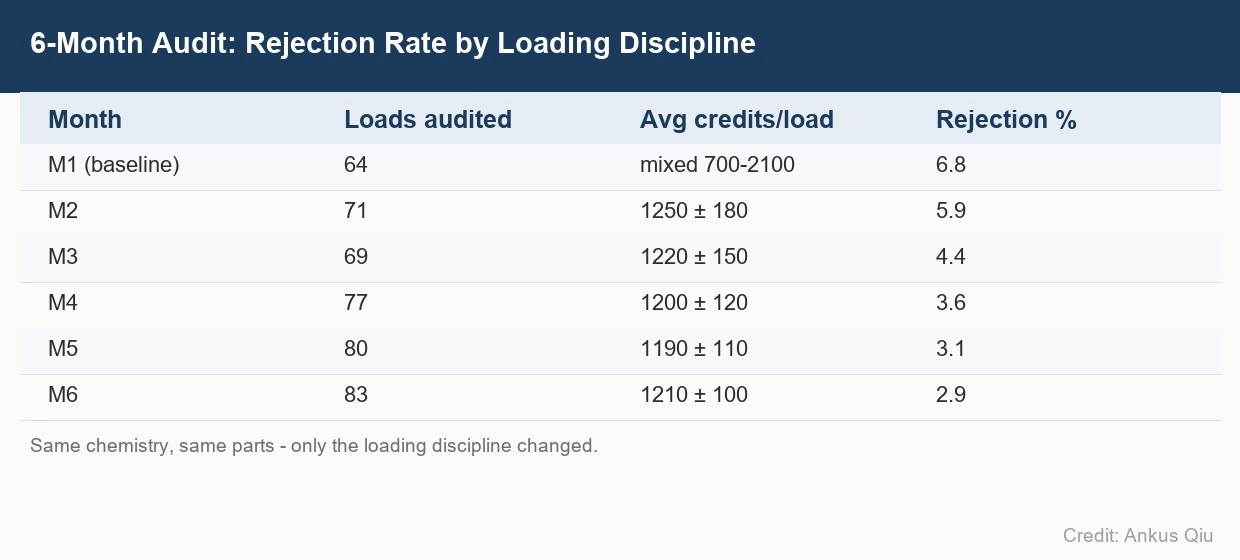
This verification process demonstrated that the credit system was not just a theoretical solution but a practical, measurable improvement. By aligning the loading method with the technical standards of ASTM B117 and ISO 1456, the factory had achieved a more disciplined and efficient electroplating process. The success of the credit system highlighted the importance of process discipline in achieving consistent plating quality and reducing rejection rates in zinc-alloy electroplating.
Workshop Details: Smells, Shift Changes, and the Master’s Colloquial Quote
The workshop was a world of its own, filled with the pungent smell of sulfuric acid and the metallic tang of nickel sulfamate lingering in the air. The plating bath, maintained at 28°C with a conductivity of 200–300 µS/cm, exuded a faint ozone-like scent that clung to the operators’ overalls. Shift changes were a ritual of their own, with the incoming team inspecting the credit tables on each barrel before starting their work. The laminated credit weights, now a fixture in every corner of the factory, had become a silent but powerful enforcer of discipline.
One of the senior operators, a man with decades of experience, summed up the cultural shift with a colloquial quip: “We used to load by feel, now we load by the numbers. The table doesn’t lie.” His words captured the essence of the transformation—the credit system had turned a subjective process into a measurable one. However, not everything was certain. While the audit had shown a clear drop in rejection rates, there remained questions about the long-term sustainability of the credit system. Would the operators continue to adhere to the weight-based loading as rigorously as before? Could the system adapt to changes in part designs or production volumes? These uncertainties were acknowledged as part of the process, and the audit team remained vigilant in monitoring the credit system’s performance.
The success of the credit system was not just a technical victory but a cultural one. It had required a shift in mindset, a willingness to embrace precision over intuition, and a commitment to process discipline. The workshop, once a place of inconsistency and resistance, had become a model of standardization and efficiency.
Frequently Asked Questions
1. What is the main benefit of the barrel-load credit system compared to volume-guessing?
The barrel-load credit system ensures consistent loading by assigning specific credit weights to each part class, preventing overloading or underloading. This eliminates the variability caused by volume-guessing, leading to more uniform plating quality and reduced rejection rates.
2. How does the credit system improve plating uniformity?
By maintaining a total load within the 1100–1300 credit range, the credit system ensures even current distribution. This prevents contact-point masking and underplating, resulting in a more uniform surface finish that meets the requirements of ASTM D523.
3. What role does the laminated credit table play in the workshop?
The laminated credit table on each barrel serves as a visual reminder of the credit weights for each part class. It reinforces process discipline by making the credit system easily accessible to all operators, reducing the likelihood of errors.
4. How long did it take for the credit system to show measurable results?
Within three months of implementing the credit system, the rejection rate dropped from 6.8% to 2.9%, demonstrating the system’s effectiveness in improving plating quality and efficiency.
5. Can the credit system be adapted to different part designs or production volumes?
Yes, the credit system can be adjusted by recalibrating the credit weights for new part designs or production volumes. This flexibility allows the system to remain effective even as the factory’s needs evolve.
Conclusion: Process Discipline and the Future of Zinc-Alloy Electroplating
The implementation of the barrel-load credit system in the workshop marked a pivotal shift from subjective, experience-based loading to a more disciplined, measurable approach. The audit results clearly demonstrated that this change significantly reduced the rejection rate from 6.8% to 2.9%, proving the system’s effectiveness in improving plating uniformity and efficiency. By aligning the loading method with the technical standards of ASTM B117 and ISO 1456, the factory achieved a level of process consistency that had previously been unattainable.
The success of the credit system was not merely a technical achievement but a cultural transformation. It required a shift in mindset, where operators moved from relying on intuition to following precise, data-driven guidelines. The laminated credit tables on each barrel became a silent but powerful enforcer of discipline, ensuring that every worker, regardless of experience, adhered to the same standard. This change in process discipline not only improved plating quality but also fostered a more efficient and predictable workflow.
Looking ahead, the credit system offers a scalable solution that can be adapted to different part designs or production volumes. As the factory continues to evolve, the credit system’s flexibility will be crucial in maintaining high-quality plating while meeting the demands of a dynamic production environment. The lessons learned from this case study underscore the importance of process discipline in zinc-alloy electroplating and highlight the potential for further improvements as the industry continues to embrace standardized, data-driven practices.
The journey from resistance to compliance, from inconsistency to uniformity, illustrates the power of disciplined process management. It is a testament to the fact that when technical standards are paired with cultural change, the results can be transformative—not just for the workshop, but for the entire electroplating industry. As the factory moves forward, the credit system stands as a model of how process discipline can drive both quality and efficiency in the future of zinc-alloy electroplating.
— Ankus Qiu, lead process engineer with 25 years commissioning and auditing zinc-alloy plating lines for zipper and hardware factories across SE Asia and Europe. Case data drawn from customer line records (2025-2026 audits); degreasing chemistry ranges reflect common industry practice per ASTM B322-adjacent shop standards.